
Veteran-Owned | 25+ Years | 185+ Five-Star Reviews
Mexican Saltillo Restoration in Miami: Stripping, Cleaning, and Protecting Handmade Clay Tile
Mexican Saltillo restoration in Miami starts with one fact most homeowners get wrong. Saltillo is not ceramic. It is not porcelain. It is not a surface you restore with a pressure washer and a coat of wax. Some homeowners search for this floor as "Spanish tile" or simply "Mexican tile restoration," but whatever you call it, treating it as a generic terracotta product is the mistake that ruins most Saltillo floors.
Not sure your floor is Saltillo at all? Plenty of Miami clay floors are machine-made terracotta, and the care schedule is different. Our guide to terracotta vs. Saltillo tile shows how to tell them apart in a minute.
Mexican Saltillo is handmade clay tile from Saltillo, Mexico, air-dried, kiln-fired at lower temperatures than ceramic, and extremely porous. Every tile is slightly different. Every floor absorbs differently. And in Miami's humidity, every failed coating system creates a different problem.
Keep It Clean Tile and Grout has been restoring Saltillo floors throughout Miami-Dade County and the Florida Keys since 2002. Our process is technical and chemical, not mechanical. We strip failed coatings, clean the clay at depth, stabilize it against South Florida moisture, and apply breathable protection that lasts.
📞 (305) 741-9729, call or text to schedule your assessment.
Short answer
Can a yellowed or cloudy Saltillo floor in Miami be restored?
In most cases, yes. Yellowing and cloudy white patches usually come from old wax or a non-breathable sealer trapping slab moisture, not from the clay itself. We strip the failed coating with chemistry matched to it, clean the clay with low moisture, let it dry, and protect it with a breathable finish that lets moisture escape. We never grind or hone Saltillo, because that removes the fired skin that protects the tile.
Why Saltillo Fails in Miami
Most Saltillo floors in Miami-Dade are not failing because of the clay. They are failing because of what has been applied on top of the clay over the years.
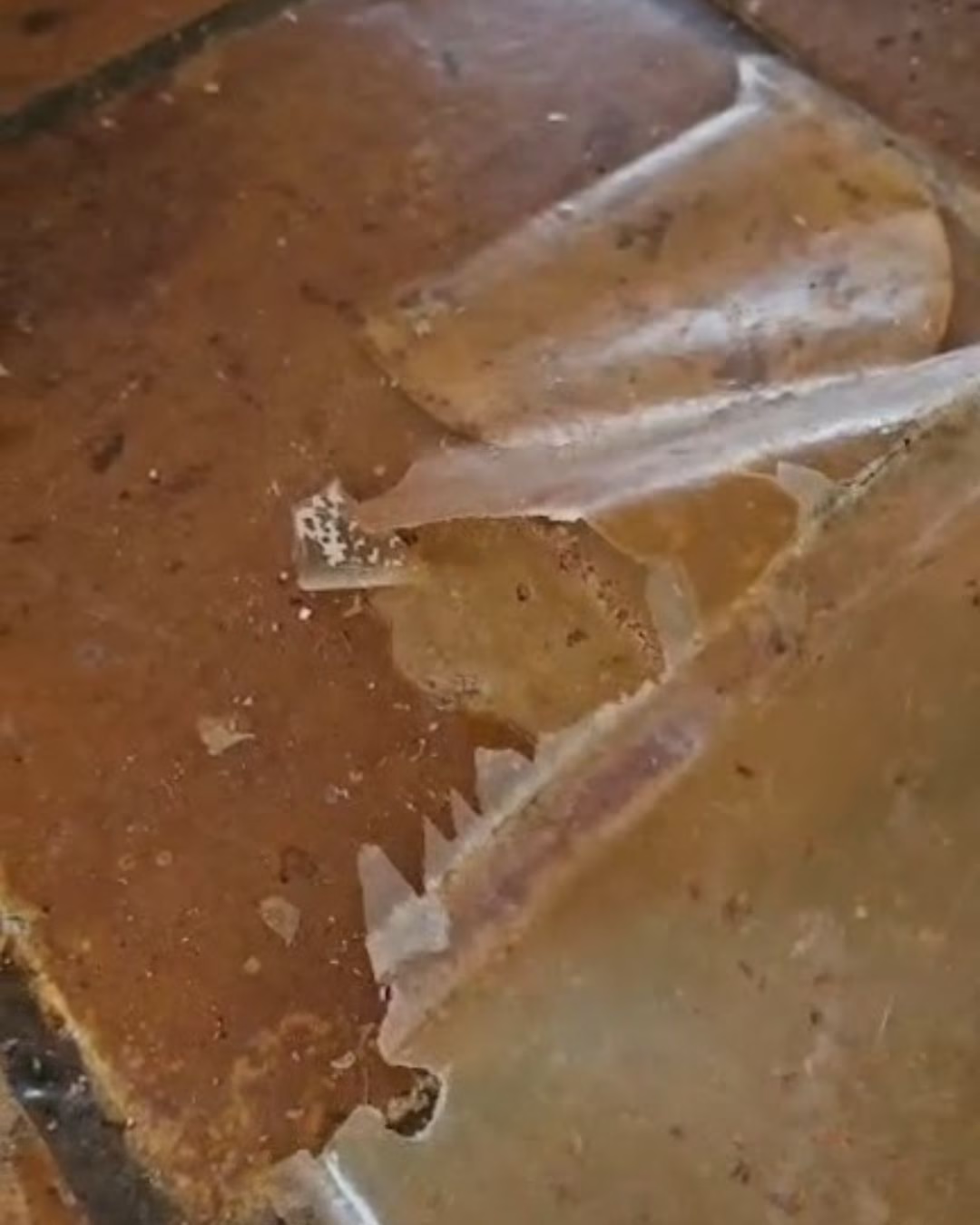
Wax and Acrylic Coating Buildup Standard floor waxes and low-grade acrylic sealers were the maintenance standard for Saltillo throughout the 1980s and 1990s. Each coat went on over the last without full removal. Over years and decades these layers oxidized, yellowed, and began to break down, trapping contamination beneath them and preventing the clay from breathing. What most homeowners think is natural discoloration in their Saltillo is oxidized coating buildup. The original clay color is often still intact underneath.
Non-Breathable Sealers Trapping Moisture Miami's humidity is constant. When non-breathable topical coatings are applied to Saltillo in a South Florida climate, moisture from the slab migrates upward through the porous clay and becomes trapped beneath the coating. The result: cloudiness, whitening, blushing, and soft spots that appear within months of application. This is not a product failure, it is a specification failure. The wrong sealer was used for the environment.
Efflorescence from Moisture Migration White powdery deposits on the surface of Saltillo are mineral salts carried upward by moisture moving through the clay. Efflorescence cannot be sealed over, it must be chemically addressed from the surface before any protective finish is applied.
Mechanical Damage from Improper Restoration Saltillo has a protective fired surface called the fire-skin. Contractors who treat Saltillo like marble, grinding and honing mechanically, permanently damage the fire-skin and expose the softer unfired clay interior beneath. Once the fire-skin is removed, the tile becomes more porous, more fragile, and more difficult to protect. This damage is irreversible.
Watch the Saltillo Restoration Process
See why Miami homeowners trust us to handle the delicate stripping and deep-cleaning of handmade clay tiles without damaging the stone's integrity.
What We Do Instead
Our Saltillo restoration process is chemical and controlled. No aggressive mechanical grinding. No flooding the clay with product. No shortcuts that create new problems.
Stage 1, Coating Identification Before any chemical is applied, we identify what is on the floor. Wax, acrylic, urethane, oil-based, and unknown legacy sealers each require a different stripping approach. Applying the wrong stripper to the wrong coating can drive contamination deeper into the clay. We test first.
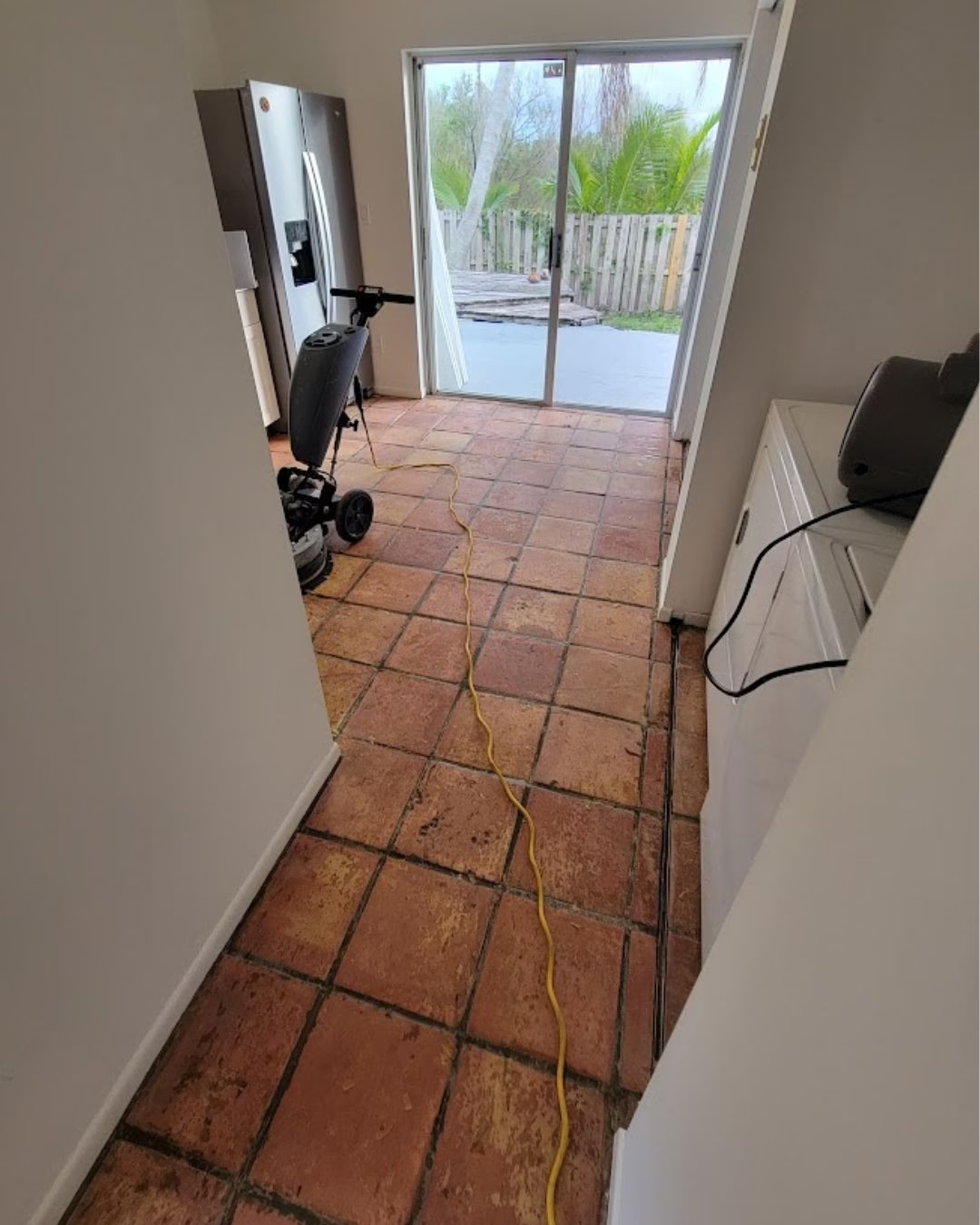
Stage 2, Controlled Chemical Stripping We remove failed coatings, wax buildup, and oxidized acrylic layers using clay-safe stripping chemistry applied at controlled dwell times. Mechanical agitation assists penetration without abrading the fire-skin. This stage exposes the authentic clay surface, original pits, handmade variation, color movement, everything the failed coatings were hiding.
Stage 3, Deep Porosity Cleaning and Neutralization After stripping, residual alkaline chemistry and loosened contamination are fully extracted and neutralized using a pH-balanced rinse. Skipping neutralization causes finish failure. This stage is not optional.
Stage 4, Humidity Stabilization and Controlled Drying Saltillo must be fully dry before any protective finish is applied. In South Florida, this means stabilizing the interior environment and allowing adequate dry time, often with air movers, before the coating process begins. Moisture trapped beneath a finish will cause cloudiness, blushing, and premature failure regardless of product quality.
Stage 5, Breathable Protective Finish Application We apply a vapor-permeable protective finish in thin, controlled coats. The number of coats depends on clay porosity, highly porous Saltillo may require five or more coats to build adequate wear protection. Each coat is allowed to cure before the next is applied. The result is a surface that protects the clay from contamination and wear while allowing moisture to escape rather than trapping it beneath a film.
What Saltillo Actually Is
Saltillo takes its name from the city of Saltillo in Coahuila, Mexico, where the tile has been made the same way for generations. Clay is dug locally, mixed with water, pressed into wooden molds by hand, and set out in open yards to dry in the sun before firing. That is why genuine Saltillo turns up with paw prints, leaf impressions, and thumb marks in it. Those happened in the drying yard.
The firing temperature is the detail that matters most for restoration. Ceramic and porcelain are fired hot enough to vitrify, meaning the clay body fuses into something close to glass and stops absorbing water. Saltillo is fired at far lower temperatures and never vitrifies. The finished tile stays open and absorbent, closer in behavior to an unglazed flowerpot than to a bathroom tile. Absorption commonly runs in the double digits by weight. Porcelain, for comparison, absorbs less than half a percent.
That porosity is the whole story. It is why Saltillo drinks sealer, why it stains from a spill that would wipe off any other floor, why moisture in a South Florida slab can push straight up through it, and why the wrong chemical does permanent damage instead of rinsing away. It is also why the floor looks the way it does. The color depth and movement come from an open clay body catching light differently across every square foot.
The one piece of built-in protection Saltillo has is the fire-skin, the harder surface layer created during firing. Protect the fire-skin and the tile lasts for decades. Grind it off and you are left with raw clay that no finish fully compensates for.
Stripping Versus Cleaning, and Why That Choice Decides Everything
These are two different jobs, and most disappointing Saltillo results come from someone doing the second when the floor needed the first.
Cleaning removes what is sitting on top of the finish: dirt, grease, traffic film, the ordinary soil of living on a floor. If your Saltillo has an intact, sound sealer and it simply looks dirty, cleaning is the correct answer and the cheaper one. Neutral chemistry, agitation, controlled extraction, done.
Stripping removes the finish itself. It is the right call when the coating has failed rather than just gotten dirty, and on Saltillo the coating is almost always what failed. Yellowing, cloudiness, flaking, gummy patches that grab at your socks, dark areas no amount of mopping touches, a surface that looks blotchy in raking light. Cleaning a failed coating gets you a clean failed coating. The discoloration is inside the acrylic, not on top of it.
Here is a test you can run yourself before anyone quotes you anything. Put a drop of water on a dull area and wait five minutes. If it beads and sits there, you still have coating on the floor and that coating is your problem. If it darkens the tile and soaks in, the coating is already gone in that spot and the clay underneath is exposed and drinking. Most Miami floors we assess do both in different rooms, which is exactly why the whole floor has to be brought back to one consistent starting point before anything protective goes down.
Stripping Saltillo is chemistry, not muscle. The stripper has to be matched to the coating, given a real dwell time, and kept wet while it works. A stripper allowed to dry on the tile redeposits everything it just dissolved straight back into open clay, which leaves the floor worse than when you started.
Should Saltillo Ever Be Honed?
Almost never, and this is where otherwise competent stone contractors get Saltillo badly wrong.
Honing is a grinding operation. On marble, travertine, or limestone it is the correct way to remove a damaged layer, because those stones are dense and consistent all the way through. Cut a millimeter off marble and you get more marble.
Saltillo is not consistent through its thickness. The fired outer skin is harder and less absorbent than the body beneath it. Cut through that skin and you do not get more Saltillo, you get raw porous clay that was never meant to be a wearing surface. It drinks sealer unevenly, it stains more easily, it wears faster, and no product reverses it. The tile is thinner and weaker from that point on.
There are narrow exceptions. Light abrasion can knock down a lippage edge that is a genuine trip hazard, or remove a hardened mortar smear an installer left behind. That is spot work measured in inches, done deliberately, with everyone understanding those spots will behave differently afterward. It is not a whole-floor process.
If a contractor proposes to grind or resurface your entire Saltillo floor to make it flat and uniform, they are describing damage. Handmade clay is not flat and uniform. That is the product, not a defect in it.
Sealing Options and How Often to Reseal
There are three broad approaches, and they produce genuinely different floors.
Penetrating impregnators soak into the clay and line the pores without leaving a film on the surface. They keep the matte, dry, natural look of raw Saltillo, they let moisture pass through freely, and they are the safest option in a humid climate. What they do not give you is sheen or a thick wear layer, so on a heavily used floor the abuse goes straight into the clay.
Breathable topical finishes build a thin vapor-permeable film on the surface. This is our default on interior Saltillo in South Florida. You get real wear protection and a natural matte or low satin look, and critically, moisture from the slab can still escape upward instead of collecting underneath. Highly porous floors can need five or more thin coats to build an even wear layer, each cured before the next goes down.
Non-breathable coatings and waxes are the third category, and they are the reason most of the floors we strip look the way they do. Solvent acrylics, old-style paste and liquid waxes, anything that forms a sealed film. In a dry climate they can last. In Miami they trap slab moisture against the underside of the film and the floor goes cloudy, white, or soft. We do not install them.
On timing, there is no fixed schedule. It is always up to the client and how the floor is treated. When an interior floor with a breathable finish comes due, it is often a maintenance recoat rather than a full strip. Exterior and covered patio Saltillo takes sun and rain and comes due sooner, and penetrating impregnators wear depending on how absorbent the clay is and how the floor gets cleaned. Kitchens, entries, and anywhere a dog runs come due well before the guest room does.
The single thing that extends any of it is what you mop with. Neutral pH cleaner, damp rather than wet, no steam, no vinegar, no bleach, and nothing sold as a mop-and-shine product, because that is wax and it starts the whole cycle over.
When a Saltillo Floor Cannot Be Saved
We would rather tell you this at the assessment than after you have paid for a restoration that was never going to deliver.
Ground-off fire-skin is the most common irreversible one. If a previous contractor took the surface down, those tiles are permanently more porous. We can protect them, but they absorb differently and often read slightly darker than untouched tiles around them.
Deep ghost matrix absorption is next. Years of moisture cycling and traffic can carry contamination all the way into the clay body. That is a structural change inside the tile, not a stain sitting on it. A finish softens the contrast. Nothing removes it.
Widespread cracking and hollow-sounding tiles point at a problem below the floor rather than on it: a failed setting bed, slab movement, or long-term water intrusion. Restoring a surface that sits on a substrate still in motion is money spent on the symptom.
Severe or recurring efflorescence usually means active moisture is still traveling up through the slab. Until that source is dealt with, any finish applied over it is on a countdown.
Acid burns from acid washing, a genuinely common mistake on exterior Saltillo, permanently alter the clay color where they happened. Those areas can be blended to a degree. They do not come back.
Paint in the grout joints is the one we see least often and the one with the least room to work. Ordinary acrylic paint brushed into Saltillo grout soaks into the pore structure and cures inside it rather than sitting on top. Removing it means attacking the acrylic with chemistry or abrasion that the surrounding clay will not survive. The Kendall assessment below is what that looks like in a real house.
When we find any of these, we say so plainly and describe what a realistic outcome looks like, including the cases where the honest recommendation is replacement rather than restoration.
A Kendall Floor We Turned Down, and Why
A homeowner in Kendall called about a Saltillo floor another company had already worked on. We went out to look at it. We did not take the job, and the reason is worth publishing.
Someone had painted the grout lines white with ordinary acrylic paint.
Not a grout colorant. Not a pigmented sealer made for the purpose. Regular paint, worked into the joints between handmade clay tiles. On top of that, a wax had gone down over the whole floor roughly six months earlier, wrong product and wrong method.
The wax was the recoverable half. Wax is topical. It sits on the surface, and with the correct stripper and a real dwell time it comes off. That part was fixable.
The paint was not, and the reason is structural. Saltillo grout is porous. Acrylic paint does not sit on porous grout, it soaks in and cures inside the pore structure. Breaking that bond takes chemistry or abrasion aggressive enough to attack cured acrylic. The problem is what the grout joint is surrounded by: soft, low-fired handmade clay with a fire-skin that cannot be put back. Anything strong enough to lift paint out of the joint takes the clay with it. There is no way to treat one without reaching the other.
So the honest answer was that the floor could be cleaned and the wax could come off, but the white lines were going to stay white. That homeowner had already spent real money on this floor. Taking more of it for a result we could not deliver was not something we were willing to do.
What we did instead was show them how to remove the wax themselves, and what to use. Wax removal is genuinely within reach of a homeowner who has the right product and some patience. There was no reason for that knowledge to carry a price tag on top of what they had already lost.
We did not get the job. We would make the same call again.
If you are about to hire someone for a Saltillo floor, three questions will protect you:
What product are you putting on the grout? If the answer is paint of any kind, stop the conversation there.
Is the finish breathable? In South Florida a non-breathable film over clay is not a finish, it is a countdown.
If this ever has to come off, how does it come off? Anyone who has not thought about removal has not thought the job all the way through.
Nearly everything that ruins a Saltillo floor is reversible if you catch it. Coating buildup strips. Wax strips. Yellowing is almost always the coating rather than the clay. But a few decisions cannot be undone, and paint in the grout joints is one of them.
What Drives the Cost of Saltillo Restoration
We do not price Saltillo over the phone, and any company that does is guessing. Two floors of identical square footage can differ by a factor of three depending on what is sitting on them. These are the variables that actually move the number.
How many coating layers are on the floor, and what they are. One thin acrylic is a completely different job from four decades of paste wax over acrylic over an unidentified 1980s sealer. Layer count and chemistry drive stripping time more than anything else does.
Square footage, with a floor under it. Larger jobs cost less per square foot. Small jobs still carry setup, testing, and materials, so the per-foot number looks high on a 90 square foot entry.
Interior versus exterior. Exterior and covered patio work needs longer controlled drying, depends on weather, and often carries efflorescence that has to be handled before anything else can happen.
Condition of the clay itself. Ghost matrix areas, prior grinding, chips, and cracked tiles all add assessment time and hand work.
Finish specification. A penetrating impregnator is one application. A five-coat breathable buildup on thirsty clay is five, each cured before the next.
Access and site conditions. A ground-floor home with a door to the driveway is straightforward. A high-rise unit with a reserved service elevator and a protected path from the loading area is not.
Furniture and fixtures. Moving and returning heavy pieces, and protecting cabinetry, baseboards, and thresholds through the stripping stage, is real time on the clock.
The $250 assessment is where all of this gets measured instead of guessed. We test the coating, check absorption in several areas, document the damage, and give you a real number. It is credited in full toward your service.
Cutler Bay Saltillo Restoration Case Study
This Cutler Bay floor was buried under multiple layers of failed, gummy wax and deep chemical staining that most contractors would not touch. We stripped the tile back to raw clay using controlled chemical stripping, restored the original oranges, reds, and yellows of the handmade clay, and finished with a breathable protective system designed for South Florida humidity.
What Saltillo Is Supposed to Look Like
Saltillo is handmade clay. It has natural pits, surface variation, color movement, and imperfections that are part of its identity, not defects to be corrected.
Our default restoration produces a natural matte or satin finish that reveals the authentic character of the tile. We do not attempt to make Saltillo look like polished marble. We do not apply high-gloss coatings that turn the surface into a plastic-looking film.
What we will not do under any circumstances: apply a non-breathable topical coating to Saltillo in a South Florida climate. The humidity will compromise it. The only question is how long it takes.
Honest Limitations
Ghost matrix absorption, areas where contaminants have penetrated deep into the clay body over years of traffic and moisture cycling, may remain visible after stripping and cleaning. These are structural changes inside the clay, not surface staining. A protective finish can soften contrast. It cannot erase the tile's history.
Fire-skin damage from previous mechanical grinding by other contractors cannot be reversed. If a prior restoration attempt abraded the surface, the clay in those areas is more porous and will behave differently from undamaged areas. We assess this during the initial walkthrough and explain the impact on the final result.
Cracked or broken tiles can be stabilized and color-matched but may remain visible. Saltillo is clay, it does not blend invisibly the way cementitious terrazzo can be patched.
Saltillo Restoration Projects
Coral Gables Historic Entryway A historic Coral Gables entryway with hand-painted Talavera risers required controlled chemical stripping after adhesive residue and failed topical layers left the clay stained and uneven. Two-phase exterior process: controlled strip, deep neutralization, protective finish application. Ghost matrix areas softened but remain part of the tile's history. → Read the full Coral Gables Saltillo restoration case study
West Palm Beach, 800 sq ft Yellow Acrylic Recovery A West Palm Beach homeowner contacted us after no local contractor would take on the job. Approximately 800 square feet of Saltillo buried under decades of oxidized acrylic coatings, yellow, brittle, and peeling throughout the main traffic areas. Deep strip, humidity stabilization at 74°F, five-coat NCL One buildup. The floor had not looked like authentic clay in decades. → Read the full West Palm Beach Saltillo restoration case study
Miami Beach, Coastal Saltillo Recovery A recent Saltillo restoration on Miami Beach, where salt air and year-round humidity work on handmade clay harder than they do inland. Controlled chemical stripping to lift the failed surface, full neutralization, and a breathable finish that lets slab moisture escape instead of trapping it under a film.

Service Coverage
We restore Saltillo across Miami-Dade County, including Coral Gables, Coconut Grove, Pinecrest, Kendall, Brickell, Key Biscayne, Miami Beach, Surfside, Bal Harbour, Sunny Isles Beach and Aventura, and in Monroe County from Key Largo through the Florida Keys. For a recent job in the Gables, see Saltillo restoration in Coral Gables. Saltillo usually shares a house with other hard surfaces, so we also handle terrazzo restoration in Miami, marble restoration, and travertine restoration when the floors run together.
For complex Saltillo situations with no qualified local restoration specialist available, we evaluate extended service area requests on a case-by-case basis.
A $250 assessment fee applies to all Saltillo and natural stone evaluations, paid via Zelle to confirm your appointment. The fee is credited in full toward your service.
Trusted Across Miami-Dade and Monroe County | 185+ Five-Star Reviews
★★★★★
"I bought my late grandmother's house whose flooring was all Mexican tile aka Saltillo. She was older so she never took proper care of them and her cleaning lady use any and whatever ever products. To say the floor was destroyed is an understatement. It darkened the house completely with the layers or filth... They worked ALL day long 2 days straight and it came out amazing. The house looks brand new and bright!... Very special team, it's hard to find companies with people who actually care about their company like them!"
Stephanie L., Miami
★★★★★
"Miguel is very nice, honest, and extremely knowledgeable about his craft, especially I the realm of Saltillo tile. I would recommend this veteran-owned business to anyone!"
Abigail S.
★★★★★
"Professional from start to finish. Our saltillo floors look amazing."
Miami Homeowner
★★★★★
"Honest, technical, and extremely detailed."
Brickell Client
★★★★★
"Finally found a company that understands floor restoration."
Pinecrest Homeowner
Our reviews come from real Miami-Dade and Monroe County homeowners and property managers. You can read them directly on our Google Business Profile.
Frequently Asked Questions About Mexican Saltillo Restoration in Miami
What makes Saltillo tile different from ceramic or porcelain tile? Saltillo is handmade clay tile from Saltillo, Mexico, kiln-fired at lower temperatures than ceramic or porcelain. This makes it significantly more porous, more absorbent, and more reactive to moisture, cleaning products, and sealers. Every Saltillo tile is slightly different in thickness, density, and absorption rate because each one was made by hand. Standard tile cleaning methods, pressure washing, steam, alkaline cleaners applied without dilution, can permanently damage the clay surface, burn the color, or drive contamination deeper into the porous body. Saltillo requires a fundamentally different technical approach from any other floor covering.
Can old wax or failed sealers be removed from Saltillo without damaging the tile? Yes, when the correct chemistry and technique are used. The key is identifying the coating type before selecting a stripping product, applying it at controlled dwell times, and using mechanical agitation that assists penetration without abrading the fire-skin. Using the wrong stripper, particularly highly alkaline products, can permanently discolor the clay or drive contamination deeper. We test the coating type before any stripping chemistry is applied and adjust the process to the specific coating on your floor.
Why is Saltillo turning yellow in my Miami home? In most cases the yellow color is not the natural appearance of the clay, it is oxidized acrylic or wax coating buildup. Standard floor maintenance products applied to Saltillo in South Florida oxidize over time, particularly in areas with direct sun exposure or high humidity. The layers accumulate, yellow, and eventually begin to peel and trap contamination beneath them. Professional stripping reveals the original clay color underneath. If your floor looks yellow and dull, the tile itself is almost certainly still intact.
What type of sealer should be used on Saltillo in South Florida? Saltillo in Miami-Dade's climate requires a vapor-permeable breathable finish, one that allows moisture from the slab to migrate upward through the clay and escape rather than becoming trapped beneath a film. Non-breathable topical coatings applied to Saltillo in South Florida trap moisture, causing cloudiness, whitening, soft spots, and premature coating failure. We use professional-grade breathable finish systems appropriate for the clay porosity and the specific interior environment of each project.
Can Saltillo tile be ground or polished like travertine? No. Saltillo should never be mechanically ground or aggressively honed. The protective fired surface, called the fire-skin, is what gives Saltillo its durability and resistance to contamination. Grinding through the fire-skin exposes the softer unfired clay interior, making the tile more porous, more fragile, and significantly harder to protect. Once the fire-skin is removed, the damage is permanent. If a previous contractor ground your Saltillo, we can assess the extent of the damage and explain what is realistically achievable in restoration.
How long does Saltillo restoration take in a Miami home? Most residential Saltillo restoration projects in Miami take one to two days depending on square footage, the severity of coating buildup, and the drying time required before finishing. Floors with heavy wax accumulation or significant efflorescence require additional time at the stripping and neutralization stages. Exterior Saltillo, entryways, patios, covered porches, often requires a longer controlled drying phase before any finish can be applied due to residual moisture in the substrate. We provide a specific timeline before work begins based on the actual conditions we document during the assessment.
How often does Saltillo need professional restoration in South Florida? There is no fixed schedule. It is always up to the client and how the floor is treated: foot traffic, sun exposure, and whether the floor has been cleaned correctly decide when it comes due. Floors that have been waxed repeatedly without full stripping will need restoration sooner and require more work at each cycle to address accumulated buildup. The simplest maintenance between professional visits: neutral pH cleaner, damp mop, no steam, no alkaline products.
How much does Saltillo restoration cost? We do not price Saltillo over the phone or from a photo, because doing that accurately is not possible. Cost depends entirely on what is sitting on the floor, not just how big the floor is. Two 600 square foot floors can be three times apart in price if one carries a single thin acrylic and the other has forty years of wax over acrylic over something nobody can identify. Coating layers, interior versus exterior, the condition of the clay, and the finish specification are the real drivers. The $250 assessment is where we test the coating, check absorption across the floor, and give you an actual number. It is credited in full toward your service.
Can I wax my Saltillo floors myself? You can, and it is the single most common reason floors end up needing a full strip. Store-bought waxes and mop-and-shine products build in layers, each coat going on before the last one has been properly removed. Over years those layers oxidize, yellow, and trap dirt underneath. The floor gets darker and cloudier and mopping does nothing, because the discoloration is inside the wax rather than on it. If your Saltillo currently has a breathable finish on it, the best thing you can do is a neutral pH cleaner and a damp mop. Nothing that promises shine.
My Saltillo has cloudy white patches. What causes that? Usually one of two things, and they are handled differently. Trapped moisture is the more common: a non-breathable coating went down, slab moisture rose through the clay, and with nowhere to escape it collects under the film and reads as white haze or blushing. Efflorescence is the other, mineral salts carried up by that same moisture and left on the surface as a chalky powder. Both are treatable. Neither can be sealed over, and sealing over them is exactly why the problem keeps returning for most people.
Can you just do the bad areas instead of the whole floor? For an isolated spot, sometimes. For a floor with failing coating in the traffic lanes and sound coating everywhere else, no, and we will say so up front. Saltillo only looks right when the whole floor starts from the same place. Strip a hallway and leave the adjoining room and you get a visible line where two different surfaces meet, plus two absorption rates that will age at different speeds. The real exception is genuinely separate spaces, a back patio that never reads visually against the interior floor, for example.
Is it cheaper to replace Saltillo than restore it? Rarely, and replacement is often not the same product. Restoration works with the tile you already own. Replacement means demolition, disposal, substrate prep, new material, installation, and then sealing the new floor anyway. It also means losing the original clay, which in older Miami homes is frequently better tile than what is sold today. The genuine exception is a floor with widespread cracking or hollow tiles caused by a failing setting bed or slab movement, where the problem lives under the tile rather than on it. In that case we tell you, rather than restoring a surface that is going to move again.
Schedule Your Saltillo Restoration Consultation
We serve Miami-Dade County and Monroe County / the Florida Keys.
A $250 assessment fee applies to all Saltillo and natural stone evaluations, paid via Zelle to confirm your appointment. The fee is credited in full toward your service.
The difference isn't magic. It's years of knowing exactly how to treat your floors in a tropical rainforest climate.
We restore Saltillo beyond Miami proper. For clay tile in the Gables, including hand-painted Talavera risers and stair treads, see Saltillo restoration in Coral Gables. For work further north, see Saltillo restoration in West Palm.
Veteran-Owned Surface Restoration in Miami Since 2002
Keep It Clean Tile and Grout serves homeowners, property managers, and commercial clients throughout Miami-Dade County and the Florida Keys, Saltillo restoration, terrazzo correction, travertine polishing, marble restoration, tile and grout cleaning, and stone sealing.
Always Local - Always On Time - Always Honest.