
Veteran-Owned | 25+ Years | 185+ Five-Star Reviews
Travertine Polishing in Miami: Honing, Repair and Restoration
Travertine polishing in Miami is the work we get called for most, and it is rarely just polishing. Keep It Clean Tile and Grout hones, repairs, polishes and seals travertine for homeowners, condos, and residential properties across Miami-Dade and Monroe County. With over 25 years working South Florida stone, we hone, polish, fill and seal travertine in homes, high-rises and commercial spaces.
Travertine requires precision, it's porous, soft, and sensitive to harsh chemicals. That's why we use low-moisture, eco-friendly methods paired with advanced honing and polishing systems to deliver the finish your floor actually calls for, whether that is a high-gloss polish or a natural matte, without damaging the stone.
Short answer
Can a dull travertine floor in Miami be polished back?
In most cases, yes. Dull travertine is usually etching from acids, hard water film, sand wear in the traffic lanes or a failed sealer, and none of it comes off with a mop. We hone the surface with diamonds, fill open voids, polish to the finish you want, from high gloss to a flat matte, and seal with a penetrating impregnator. If the stone is only soiled, a low-moisture clean and seal is enough, and we tell you that at the assessment.
Why Travertine Floors Lose Shine in Miami
Travertine floors in South Florida are exposed to humidity, mineral buildup, and environmental wear that cause them to lose their natural finish over time. South Florida's hard water, salt air, and heat accelerate this faster than most homeowners expect.
Travertine is calcium carbonate, which means it reacts. Anything acidic etches it on contact: citrus, wine, vinegar, and most supermarket bathroom cleaners. Those dull patches are not dirt and they will not clean off.
Then there is the water. Miami hard water leaves calcium and silica deposits that build into a film the stone cannot shed, and salt air does the same thing to a pool deck. Sand tracked in from the beach works like sandpaper underfoot, which is why traffic lanes always go first.
Most floors we are called to have all four happening at once, usually with a sealer that failed somewhere along the way. None of it comes back with a mop. Shine on travertine is a mechanical property of the surface, so restoring it means correcting the surface.
Why Travertine Polishing Requires a Specialist
Travertine is softer than porcelain and more sensitive than marble. Miami's humidity, sand, foot traffic, and improper cleaners accelerate wear.
Common Travertine Issues We Correct
- Dull or cloudy finishes
- Acid etching and chemical burns
- Scratches and traffic lanes
- Pits, holes, and open voids
- Uneven sheen or patchy appearance
Why DIY and Harsh Cleaners Fail
Acidic products, vinegar, and abrasive pads dissolve calcium and permanently damage the stone. Pressure washing forces water into pores, weakening the structure. Our low-moisture, controlled polishing system avoids these risks entirely.
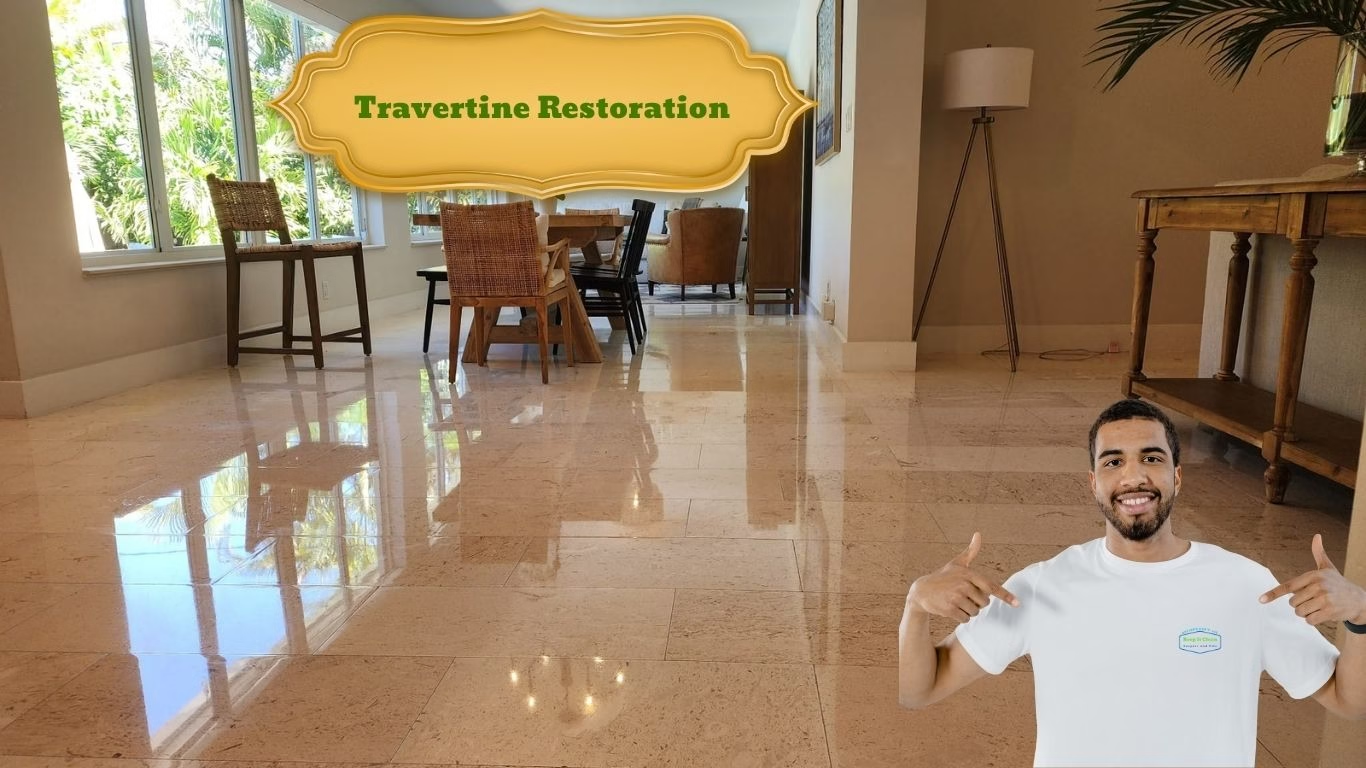
Travertine Cleaning and Sealing in Miami
Not every travertine floor needs polishing. Plenty of them need cleaning and sealing, and nothing more.
Cleaning Travertine
Travertine is porous. It holds soil down in the surface and in the filled voids, not just on top of it. Household cleaners either sit on the stone doing nothing or actively attack it, and anything acidic, vinegar included, dissolves the calcium and leaves etch marks that no amount of mopping will remove. We clean with stone-safe chemistry and controlled extraction. Low moisture, so the floor is never flooded and water is never driven down into the pores.
Sealing Travertine
Sealing is about protection, not shine. We use penetrating impregnators that soak into the stone and leave the look unchanged. We do not put topical or film-forming sealers on travertine. In South Florida humidity a film traps moisture underneath it, and when it fails it clouds, yellows and peels along the traffic lanes. That is how most of the floors we get called out to fix ended up that way in the first place.
When a Clean and Seal Is Enough
If the stone is structurally sound and the surface is only soiled, a clean and seal is the honest answer, and it costs a fraction of a full restoration. Sometimes the assessment ends with us telling you the floor is fine and you should keep your money.
A Real Job. When the Shine Isn’t Stone at All
The Surface
940 square feet of filled travertine running through the main level of a Miami home, covering the family room, the dining and living room, and the foyer and hallway.
What We Found
The floor had a reflective sheen, and the reasonable assumption going in was polished stone. It was not. On assessment the shine turned out to be wax, a topical coating sitting on top of the travertine rather than a finish worked into it. That distinction changes the entire job. Polishing a waxed floor means polishing the wax, and the result holds up for a few months before it clouds, yellows, and begins peeling along the traffic lanes.
What the Client Wanted
Not more shine. Less. She wanted the reflective finish gone entirely and the stone brought back to a uniform natural matte, with no polishing and no crystallization afterward. Polishing is the easier sell and the more profitable one, but it was not what she asked for, so we built the scope around the finish she actually wanted.
The Process
The wax came off first, stripped completely across all 940 square feet, because nothing can be done to the stone underneath while a failed coating is still sitting on it. From there we honed the travertine to 100 grit. That is a deliberately coarse hone, producing a true flat matte with no reflection rather than the soft satin most people mean when they say honed. A water-based stone sealer went down last, penetrating rather than topical, so the floor is protected without adding back any of the sheen she had just paid to have removed.
The Result
A uniform matte floor across the entire main level, sealed, with no coating on it left to fail later. Her words when she saw it: "It's exactly what I wanted."
A different floor, in Coral Gables, that went the other direction. This one was not polished stone either. It carried a synthetic topical coating that was wrong for travertine, so instead of shedding dirt the floor kept holding it. The coating came off first, then the stone was honed to a flat matte with no shine, which is what the owner asked for. Same principle as the job above: whatever is sitting on top has to come off before anything can be done to the stone underneath.
Residential and Commercial Travertine Polishing
Homes and Condos
We service residences, penthouses, and condos throughout Miami-Dade County, Monroe County, and South Florida. Travertine rarely sits alone in a Miami house, so we also handle marble restoration in Miami, limestone restoration, and terrazzo restoration on the same visit where the floors run together.
Commercial and High-Traffic Spaces
Lobbies, hallways, offices, retail spaces, and restaurants trust us for consistent, professional stone restoration.
A Real Job. When the Marble Isn’t Marble
The Surface
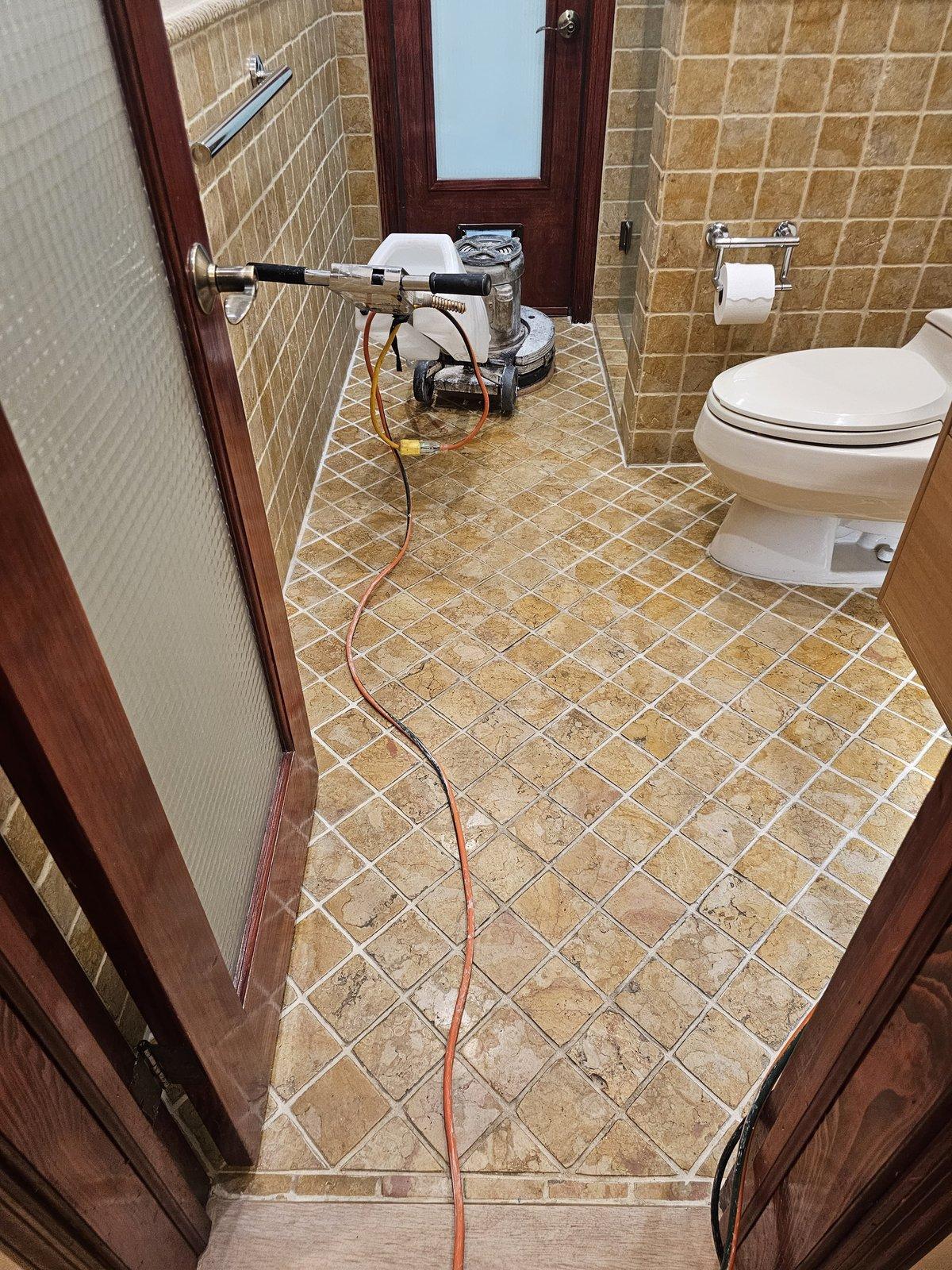
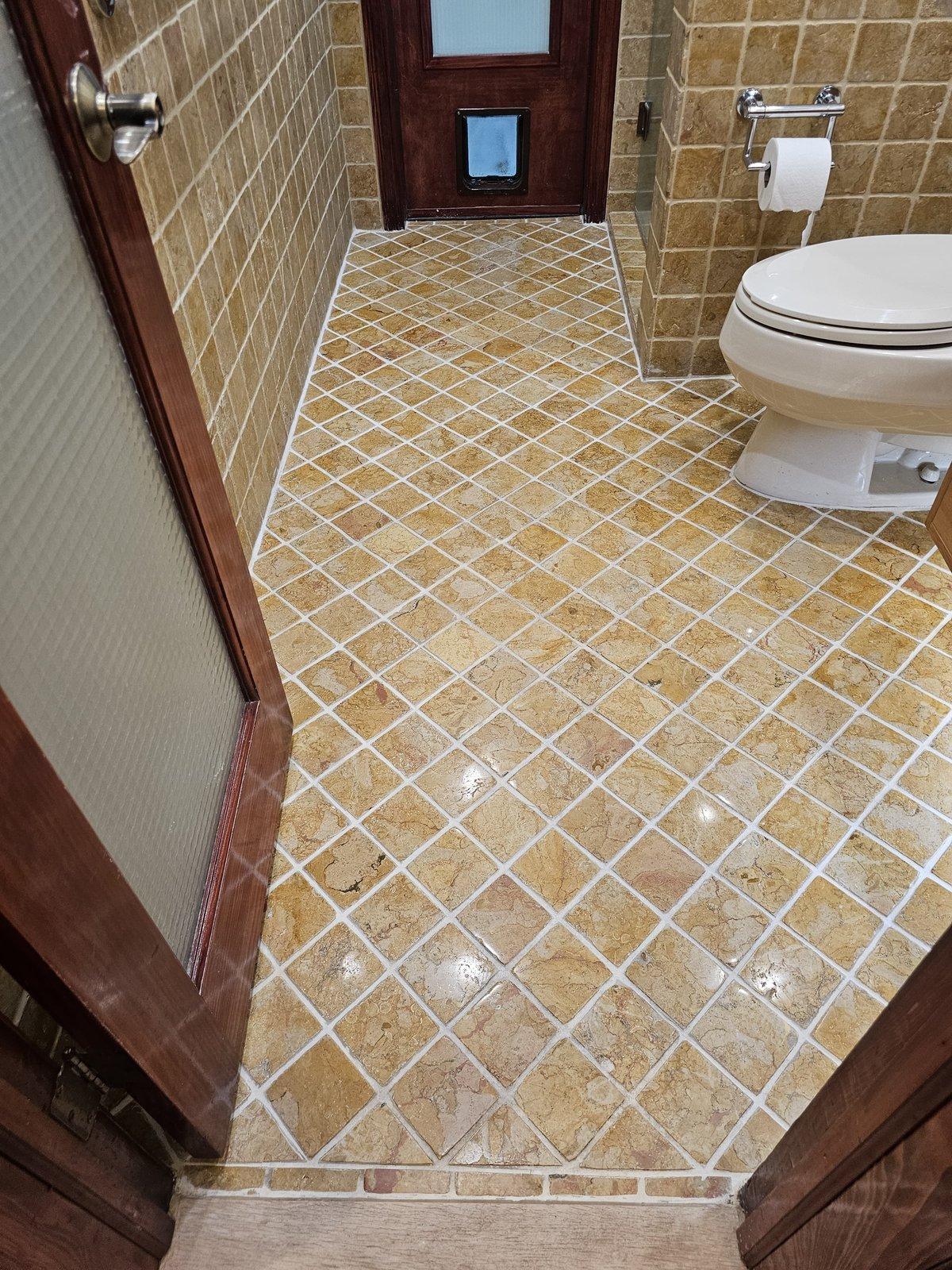
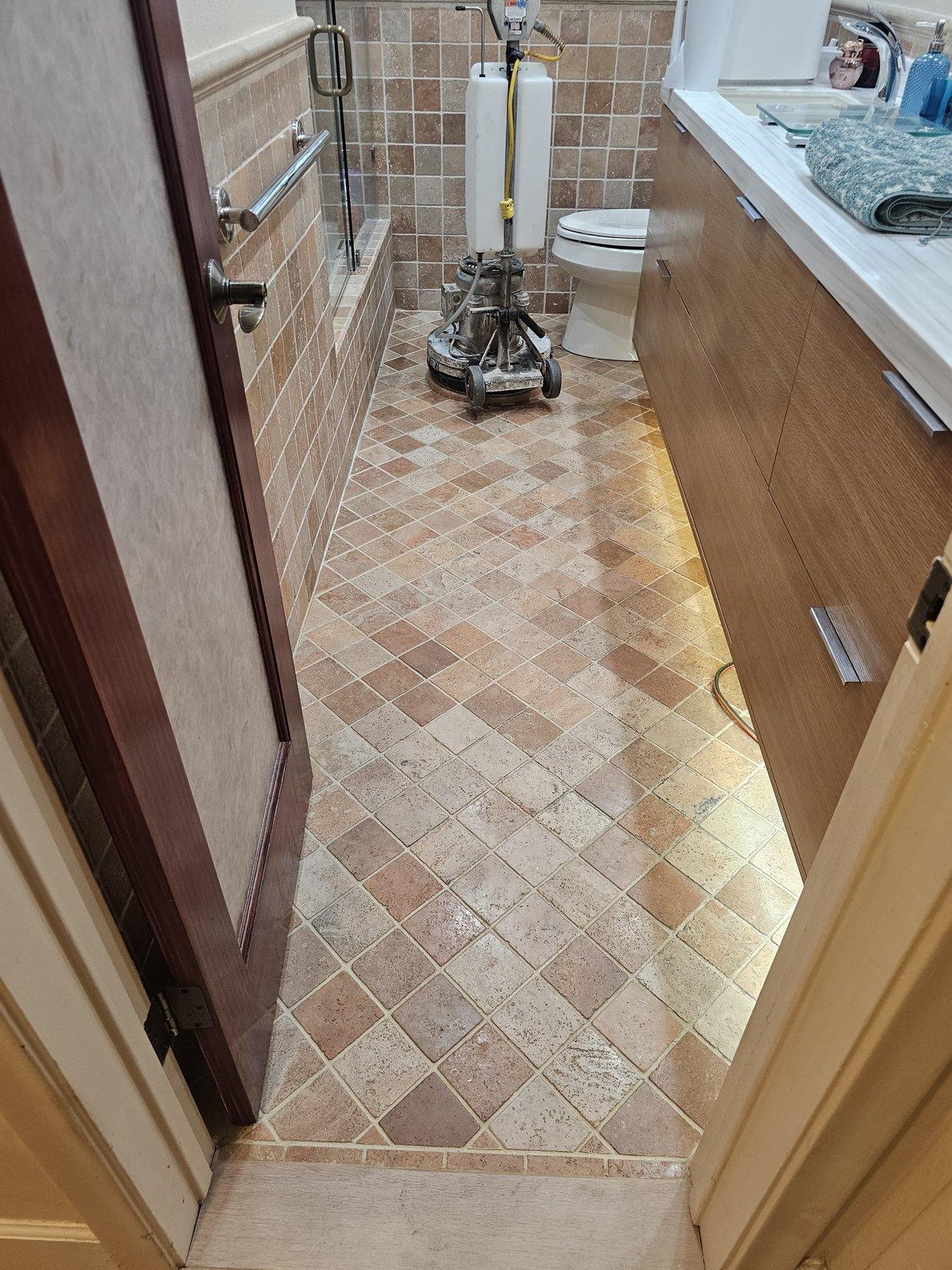
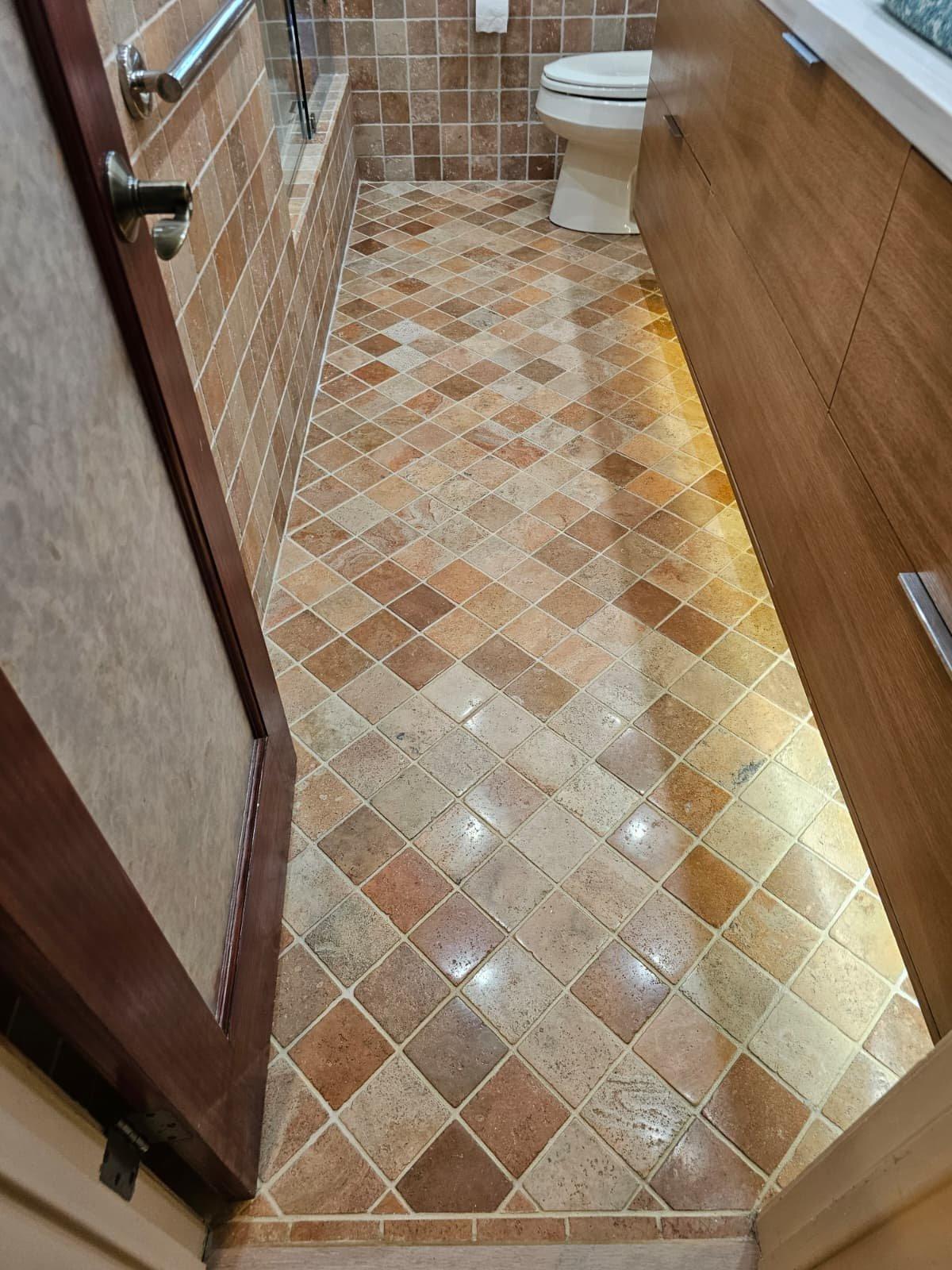
Two small bathroom floors in a Kendall home. Tumbled travertine in roughly four inch squares, set on the diagonal. Floors only. The walls were in good shape and stayed out of the job.
Two small bathrooms is not a big job. The process does not change with the size of the room. A failed coating has to come off whether it covers nine hundred square feet or ninety, because nothing done on top of it is going to hold.
What We Found
Two problems, and the second one explains the first.
The floors were coated in an acrylic sealer. Acrylic sits on top of stone instead of soaking into it, and tumbled travertine is porous and full of open pitting, so a topical coating has nothing solid to hold on to. It had gone patchy, trapping soil in the low spots and wearing through along the traffic lanes. What looked like dirty floors was mostly a failing film.
The floors had also been described to us as tumbled marble. They are travertine. That is a common mix up, and not a careless one, because tumbled travertine gets sold under the marble name all the time. But it matters. Marble and travertine do not take the same chemistry and they do not take the same sealer. Treat travertine like marble and you can end up with exactly this, a coating on a stone that was never going to hold it.
What the Client Wanted
No specification and no shopping list. Clean the floors, and whatever else we recommend. That is the kind of job where the assessment does the real work, because the customer is telling you plainly that they do not know what is wrong, only that the floors are not right.
The Process
The coating came off first. Nothing can be done to the stone underneath while a failed acrylic is still sitting on it, so the strip ran across both floors before anything else started.
Then the cleaning, with our low moisture system, chemistry and controlled extraction. No pressure washing and no steam. Travertine is calcium carbonate and the tumbled finish holds soil down inside the pitting, so the work is about lifting what sits in the stone rather than scouring what sits on top of it.
With the floors clean and bare, we polished the stone. That is mechanical work on the travertine itself, not a product applied over it. On a tumbled floor it brings sheen up on the faces of the tiles while the tumbled edges and the open pitting stay exactly as they are, because that is the character the stone was made with.
Sealing went down last, penetrating rather than topical. The stone is protected without another film on it waiting to fail.
The Result
The travertine reads as travertine. Its own color and its own variation showing, instead of a yellowed coating over the top.
Worth being clear about what the shine on these floors is now, because it is the whole point of the job. The old floors had a shine too. That one came from a plastic film lying on the surface, and it was busy going patchy and wearing through. The shine on them now comes from the stone itself, polished. Nothing is sitting on top of it that can cloud, lift or peel later.
Same look from the doorway. Completely different thing underfoot.
Why Miami Trusts Keep It Clean Tile and Grout
- 25+ years of professional stone restoration experience
- Veteran-owned, family-operated
- 185+ five-star reviews from Miami homeowners and businesses
- Eco-friendly, low-moisture stone care systems
- Trusted in condos and commercial properties across Miami-Dade
We don't outsource. We don't rush. We do the work right.
Trusted Across Miami-Dade and Monroe County | 185+ Five-Star Reviews
We also serve Monroe County and the Florida Keys. See our travertine restoration services across the Keys →
★★★★★
"I couldn't believe the difference! Our travertine floors were in terrible shape... They explained the process, showed incredible attention to detail, and treated our home with respect."
Antonio M., Miami
★★★★★
"Wow! Service was amazing. Great communication from start to finish... 100% recommend this service and will use them again."
Elizabeth S.
★★★★★
"Professional from start to finish. Our travertine floors look incredible."
Coral Gables Homeowner
★★★★★
"Honest, technical, and extremely detailed."
Brickell Client
★★★★★
"Finally found a company that understands stone restoration."
Pinecrest Homeowner
We work regularly across Miami-Dade County, Monroe County, and South Florida. See our Coral Gables travertine restoration service → and Miami Beach travertine restoration →
Frequently Asked Questions About Travertine Cleaning and Polishing
Q: How often should travertine floors be polished in Miami?
A: There is no fixed schedule. It is always up to the client and how the floor is treated: the cleaning solutions used on it, the foot traffic, and the sand tracked in from the beach decide how fast travertine wears. We check the wear during the $250 assessment, credited in full toward the service, and tell you what the floor needs now.
Q: Can you clean dirty grout lines without damaging the travertine stone?
A: Yes. Travertine requires stone-safe methods. We use a specialized tile and grout cleaning process that removes embedded soil from grout lines without acidic cleaners or abrasive techniques that can etch or weaken the stone.
Q: Do you repair holes and voids in travertine?
A: Yes. Travertine repair is part of most restorations we run in Miami. We fill pits, holes, chips, and natural voids with color-matched travertine filler, then hone the repair flat with the surrounding stone so it takes the same finish as the rest of the floor. On a floor with widespread open voids, filling is usually the longest stage of the job.
Q: Is polishing safe for old or damaged travertine?
A: Yes. Our process is designed to restore and protect aging stone without aggressive chemicals.
Q: Do you offer sealing after polishing?
A: Yes. We use a penetrating sealer that slows absorption and lets the stone release moisture, rather than a film that sits on top of it.
Q: Can you restore heavily etched or stained travertine?
A: Yes. We use professional honing to remove etching, wear patterns, and surface damage, followed by polishing to restore a smooth, uniform finish. Most stains and dull areas are corrected without replacing the stone.
Q: Should I refresh the grout color during a stone restoration project?
A: In many cases, yes. After stone restoration, grout lines often stand out more. If the discoloration does not clean out, grout color sealing can be applied after polishing to bring the grout back to a uniform color.
Q: How do I know if my travertine is polished stone or just waxed?
A: Test an inconspicuous spot with your fingernail. Wax scratches and leaves a visible mark, polished stone does not. Waxed floors also tend to look glossy but feel slightly tacky, and they usually show cloudy patches or peeling along traffic lanes. The distinction matters because polishing a waxed floor only polishes the coating, and it will cloud and peel again within months. A waxed floor has to be stripped completely before any stone work begins.
Q: Can travertine be honed to a matte finish instead of polished?
A: Yes, and we get asked for it regularly. Honing removes the reflective finish and leaves a uniform natural surface with no shine. The grit determines how flat the result is, a coarser hone produces a true matte with no reflection while a finer hone leaves a soft satin. We finish with a penetrating sealer rather than a topical coating, so the floor is protected without any sheen being added back.
Q: Do you provide commercial travertine polishing in Miami?
A: Yes. We provide commercial travertine polishing throughout Miami and surrounding cities, including high-rise condos, lobbies, and retail spaces. Our low-moisture process is well suited to high-rise properties, where access, elevators, and building regulations are critical to the success of the job.
Q: How much does travertine polishing cost in Miami?
A: A $250 assessment fee applies, paid via Zelle to confirm your appointment, credited in full toward your service. Final pricing depends on square footage, damage severity, and whether repairs or sealing are needed. We assess every job before quoting, we don't quote from a price list because the scope determines the cost.
Ready to Restore Your Travertine Floors?
We serve all of Miami-Dade County, Monroe County, and South Florida.
A $250 assessment fee applies to all hard surface evaluations, paid via Zelle to confirm your appointment. The fee is credited in full toward your service.
The difference isn't magic. It's years of knowing exactly how to treat your floors in a tropical rainforest climate.
Always Local - Always On Time - Always Honest.
We work travertine across Miami-Dade and Monroe County. If your job is outside Miami proper, these cover the same work in your area: travertine restoration in Kendall, travertine restoration in Coral Gables, travertine cleaning and sealing in the Florida Keys, travertine cleaning and sealing in Key Largo, and travertine polishing in Big Pine Key. For travertine showers specifically, see stone shower sealing in Key Largo.
Page last reviewed and updated September 16, 2026.