
Veteran-Owned | 25+ Years | 185+ Five-Star Reviews
Limestone Restoration in Miami
Limestone is the softest and most absorbent stone in most South Florida homes. It sits in entryways, on pool decks, up staircases, and across wall cladding, and it takes on moisture, oil, and staining from the inside rather than from the surface. That is why mopping never fixes it, and why pressure washing usually makes the next problem worse.
Keep It Clean has restored limestone across Miami-Dade and the Florida Keys since 2002. Low-moisture chemistry matched to calcium-based stone, controlled extraction, mechanical honing where the surface needs it, and a breathable sealer built for limestone. Never high pressure, never acid, never steam.
Why Limestone Needs Different Handling
Limestone is calcium carbonate, a sedimentary stone that is softer and far more porous than marble or granite. In a subtropical climate it behaves like a sponge for moisture and oils.
It etches. Limestone is chemically reactive. Vinegar, lemon, bleach, and most supermarket bathroom cleaners burn the surface on contact. Those dull patches are not dirt, they are chemical damage, and no amount of cleaning removes them.
The soil is inside the stone. Unlike porcelain, where dirt sits on top, staining in limestone lives down in the pore structure. Surface cleaning moves it around. Extraction pulls it out.
It has to be corrected mechanically. Where the surface is etched or worn, we hone the stone with weighted planetary machines and diamond-impregnated pads to take off the compromised layer and expose sound stone underneath. That is restoration, not polish over a problem.
Pressure washing is the fastest way to ruin it. High pressure opens the surface, drives water into the joints, and leaves the stone more absorbent than before. The next round of staining then arrives faster and deeper.
A Real Job — Limestone Entry on a Pinecrest Purchase
A Pinecrest home changed hands, and the covered entry was the first thing anyone saw walking up to it. The limestone landing and steps had gone blotchy and uneven, pale in places, dull and mottled in others, in a pattern that had nothing to do with where people walk.
That pattern is the tell. Traffic wear follows the path feet take. This did not, which meant the discoloration was in the stone rather than on it, and no amount of surface cleaning was going to touch it.
Pressure washing would have been the fast answer and the wrong one. We worked it low-moisture instead, with chemistry matched to calcium-based stone and controlled extraction to pull what was sitting in the pores back out, then brought the finish to one consistent tone across the landing, the steps, and the step nosing.
Same stone. Nothing replaced, nothing ripped out, no acid.
The same house needed grout work inside, which we handled as a separate job. If your tile reads cloudy after a renovation or a purchase, that is a different problem with a different fix. See grout refresh and color sealing in Miami.


A Second Job, Shellstone Haze Removal in Miami Beach
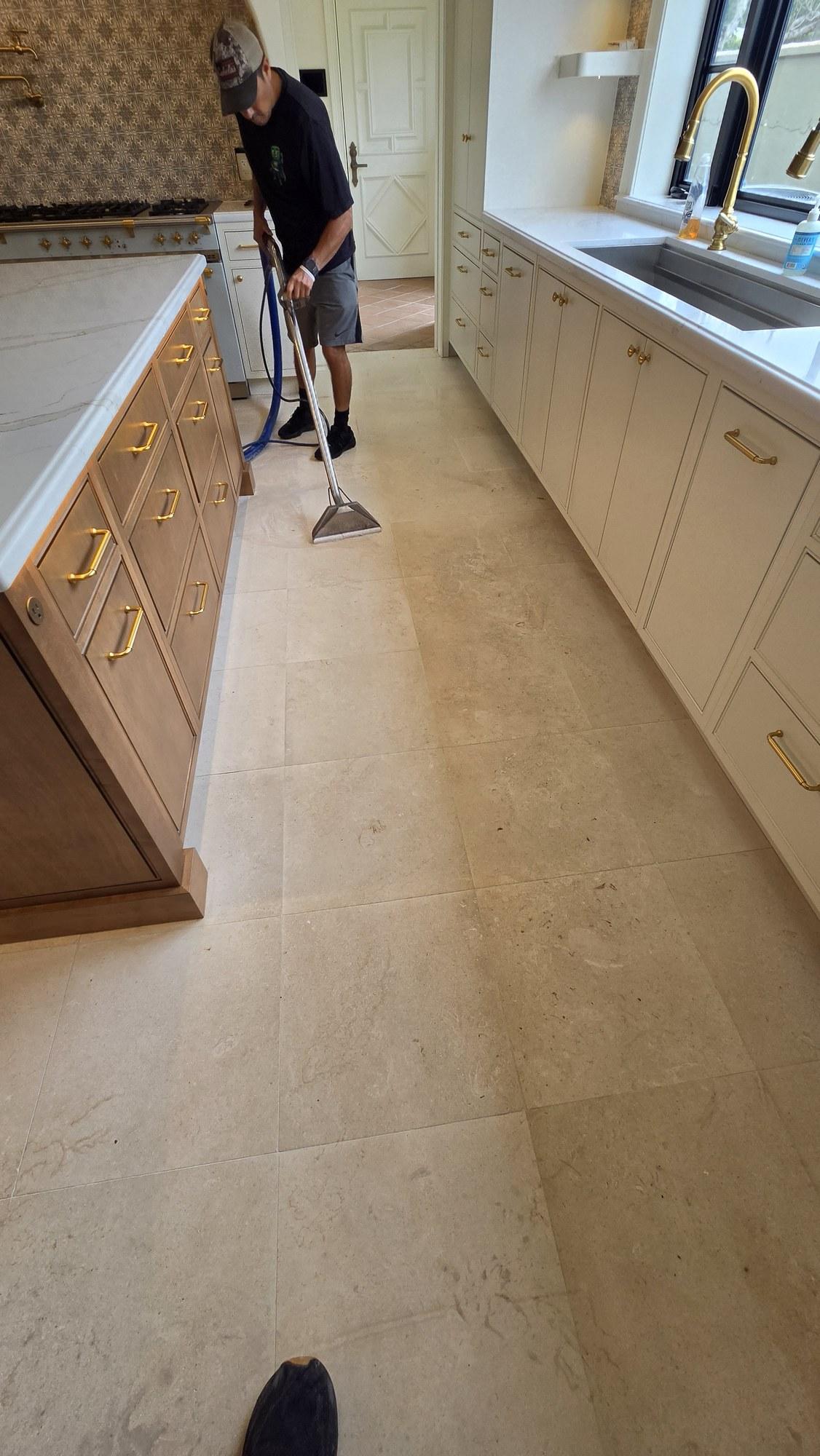
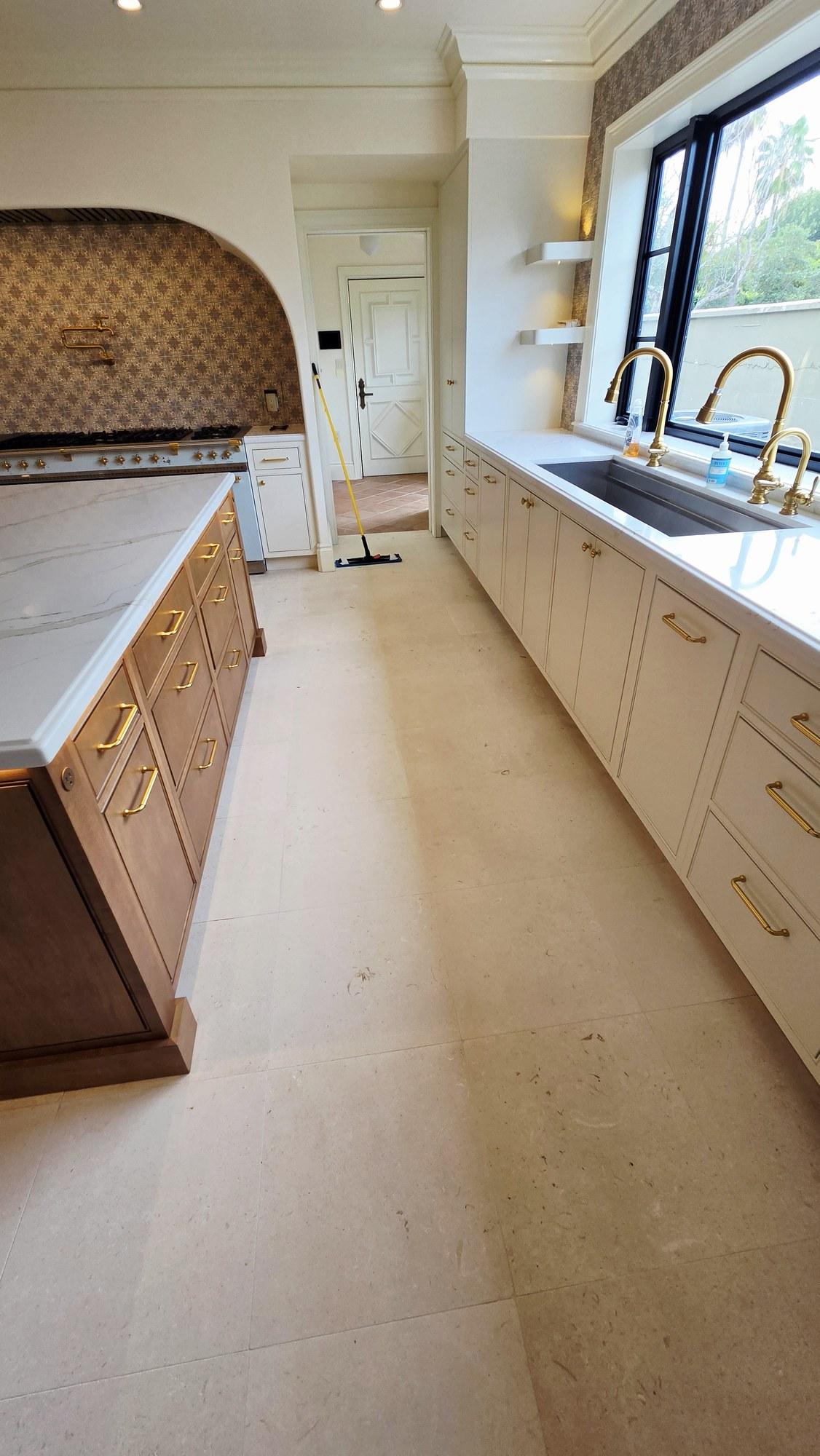
Shellstone is a limestone. Soft, porous, and full of open fossil voids that hold whatever settles into them, which is why limestone cleaning on a floor like this is a different job from cleaning tile.
This one is in Miami Beach, in a home still in the middle of a full renovation. The stone went down early, which made it the first surface installed and one of the first to take abuse. The owners covered it, and it stayed covered for more than a year. Construction residue found its way in anyway, because limestone absorbs from the inside rather than collecting on top.
A hazy shellstone floor is not dirty the way people assume. The residue sits in and just under the surface, and scrubbing harder only burnishes it in. Pressure washing would have driven it deeper and left the stone more absorbent than it started.
We worked it low moisture. Chemistry matched to calcium-based stone, an orbital machine to keep the surface even, and controlled extraction to pull the residue back out rather than push it around. Then the floor was dried down and a penetrating sealer went into the stone.
Nothing film-forming went on top. The renovation in this house is still going, and the floor is ready for the rest of it.
Our Limestone Restoration Process
Inspection and preparation. We read the stone first, its finish, its condition, whether it has been sealed before, and whether what you are looking at is soil, etching, or a coating that has failed. The plan comes from what the floor actually is, not from a standard package.
Deep cleaning and honing. Weighted planetary machines with diamond-impregnated pads and a low-moisture cleaning system lift embedded soil and take down etching without flooding the stone or the joints.
Refinishing. We bring the surface back to a uniform finish through mechanical refinement rather than a topical shine, so the clarity you see is the stone itself.
Protection. A breathable, sub-surface penetrating sealer made for calcium-based stone, which slows absorption without changing the look or trapping moisture inside the slab.
Stone-Safe, Non-Acidic Limestone Care
Every product we put on limestone is non-acidic and safe for delicate natural stone, indoors and out. Floors, countertops, staircases, pool decks, and wall cladding. Safe for the household once dry, which in normal South Florida ventilation is typically 30 to 60 minutes.
We work limestone alongside marble, travertine, terrazzo, coral stone, and Saltillo, and we calibrate the process to the density of each so the finish stays consistent where one stone meets another.
Trusted Across Miami-Dade & Monroe County | 185+ 5-Star Reviews
★★★★★
"Professional from start to finish. Our stone looks incredible."
— Pinecrest Homeowner
★★★★★
"Honest, technical, and extremely detailed."
— Coral Gables Client
★★★★★
"Finally found a company that understands stone restoration."
— Miami Beach Homeowner
Our reviews come from real Miami-Dade and Monroe County homeowners and property managers. You can read them directly on our Google Business Profile.
Rated ★★★★★ on Google
Frequently Asked Questions — Limestone Restoration in Miami
Q: How much does limestone restoration cost in Miami?
A: A $250 assessment fee applies, paid via Zelle to confirm your appointment, credited in full toward your service. Final pricing depends on square footage, the condition of the stone, and whether the surface needs honing or only cleaning and sealing. We assess every job before quoting, because with limestone the scope is not visible from a photo.
Q: Can you remove stains and etching from limestone?
A: Usually, and they are two different problems. Deep organic staining comes out with a poultice extraction that draws pigment up out of the pores. Etching is chemical damage to the surface itself and is corrected by honing the stone down to a sound layer. We tell you which one you have before we start.
Q: Why can't I just pressure wash my limestone?
A: Because it works once and costs you the stone. High pressure erodes the softer calcium structure, opens the pores, and forces water into the joints. The floor looks brighter for a season and then stains faster and deeper than it did before. We use low moisture and controlled extraction for exactly this reason.
Q: Does limestone need to be sealed?
A: Yes. It is highly porous and it absorbs moisture, spills, and humidity continuously in this climate. We use a breathable impregnating sealer designed for calcium-based stone, which slows absorption without sitting on the surface or trapping moisture underneath.
Q: Can limestone be restored where it meets marble or other stone?
A: Yes. Our systems are calibrated to the density of each stone, so we can hold a consistent finish across a transition rather than leaving one surface brighter than its neighbour.
Q: How often should limestone be refinished?
A: Every two to three years in a home, sooner in high-traffic commercial settings or on exterior stone that takes weather and pool chemistry year round. Sealing on schedule stretches the interval considerably.
Q: Are your products safe indoors, around pets and children?
A: Yes. Everything we use on limestone is non-acidic, odor-free, and safe for occupied homes once the surface has dried.
Q: Do you service limestone throughout Miami-Dade and the Keys?
A: Yes. Homes, estates, condos, and commercial properties across Miami-Dade County, Monroe County, and the Florida Keys. Call or text 305-741-9729 to confirm your address and schedule your assessment.
Limestone Restoration in Miami — Schedule Your Assessment
If your limestone has gone dull, blotchy, or etched, or you have just bought a house and the stone is not what it should be, the next step is an assessment. We look at the floor, tell you whether it needs cleaning, honing, or sealing, and give you a realistic picture of the result before any work starts.
A $250 assessment fee applies, paid via Zelle to confirm your appointment, credited in full toward your service.
Call or text 305-741-9729