
Orange clay floors are all over Miami, from Coral Gables Mediterranean homes to Miami Beach condos and Keys houses, and most homeowners call every one of them saltillo. A lot of them are not, and terracotta vs saltillo is one of the first things we sort out on a clay floor. Knowing which one you have changes how often the floor needs care, and it changes what a restoration crew should plan before they ever start.
By Miguel Cedeno, owner of Keep It Clean Tile and Grout. Veteran-owned, 25+ years restoring tile and stone in Miami-Dade County and the Florida Keys.
Short answer: Terracotta is the broad category of clay tile. Saltillo is one specific kind of terracotta: handmade, sun-dried clay tile that comes only from the area around Saltillo, Mexico. Think of it like wine and Champagne. All Champagne is wine, but not all wine is Champagne. The everyday cleaning chemistry is the same for both, but saltillo is much more porous than machine-made terracotta, so it needs maintenance more often.
Terracotta vs Saltillo: How Do You Tell Them Apart?
Terracotta can be made anywhere in the world, in many styles, and it can be perfectly smooth and uniform. Saltillo is made in one place, the old-school way. Three things give it away.
- The look. Machine-made terracotta is usually smooth, flat, and an even reddish brown. Saltillo is wild: wavy surfaces, bumpy edges, and blends of peach, yellow and red in the same floor.
- The "flaws." Saltillo tiles are dried outside in the sun, so it is very common to find dog paw prints, bird tracks or leaf imprints baked right into the tile. Machine-made terracotta does not have these.
- The fit. Machine-made terracotta tiles are all the same size. Saltillo tiles are handmade, so each one is a slightly different shape and size, which is why saltillo floors are laid with thick grout lines between them.
| At a glance | Machine-made terracotta | Saltillo |
|---|---|---|
| Where it is made | Anywhere in the world | Only around Saltillo, Mexico |
| Surface | Smooth and flat | Wavy, bumpy edges |
| Color | Even reddish brown | Blends of peach, yellow and red |
| Marks | None | Paw prints, bird tracks, leaf imprints |
| Tile size | All the same | Slightly different, handmade |
| Grout lines | Thin | Thick |
| Porosity | Less porous | Much more porous |
| Maintenance | Less often | More often |
What Stays the Same, and What Changes
Because saltillo is a specific type of terracotta, both are raw clay and both follow the same basic rules. The everyday cleaning chemistry is exactly the same.
The difference is porosity. Saltillo is much more porous than standard machine-made terracotta, so it takes in more of whatever lands on it and it needs maintenance more often. Treat a saltillo floor on a terracotta schedule and it falls behind. That is why we always look at a clay floor in person before we plan the work. Photos rarely tell the whole story.
Clay Floors and South Florida Humidity
What works on clay floors in South Florida only works in South Florida. Clay is raw and porous, and Miami humidity is always trying to move through it. When a floor gets buried under layers of wax or acrylic that were never stripped, that moisture gets trapped, and the old coating oxidizes into the yellow-brown haze people mistake for old tile. The clay underneath usually has not changed at all.
That is why the first step on a buried clay floor is usually chemistry to strip the old layers, and the last step is a finish that lets humidity escape instead of trapping it under the surface. On saltillo and terracotta alike, the goal is to protect the clay without burying it.
If your floor turns out to be saltillo, see our saltillo restoration in Miami page, or saltillo restoration in Coral Gables.
A Real Job: California Terracotta in Miami Beach
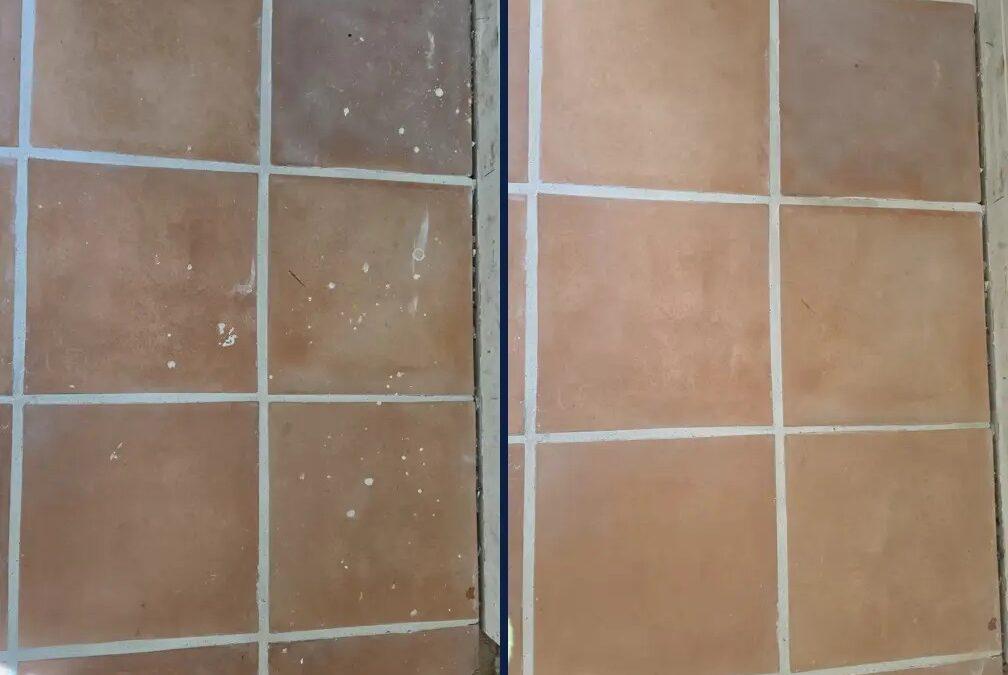
The floor in the before and after at the top of this page, in a Miami Beach home, looks like saltillo at a glance. It is not. It is 100% terracotta from California: uniform squares, sharp edges, even color, thin grout lines.
It came to us with rust streaks across several tiles, white paint splatter, and a white cement haze along the grout lines. The work was low-moisture from start to finish, chemistry plus controlled extraction, with no high pressure and no steam. We removed the rust, the paint and the haze, then finished with a transparent sealer so the clay keeps its natural look.
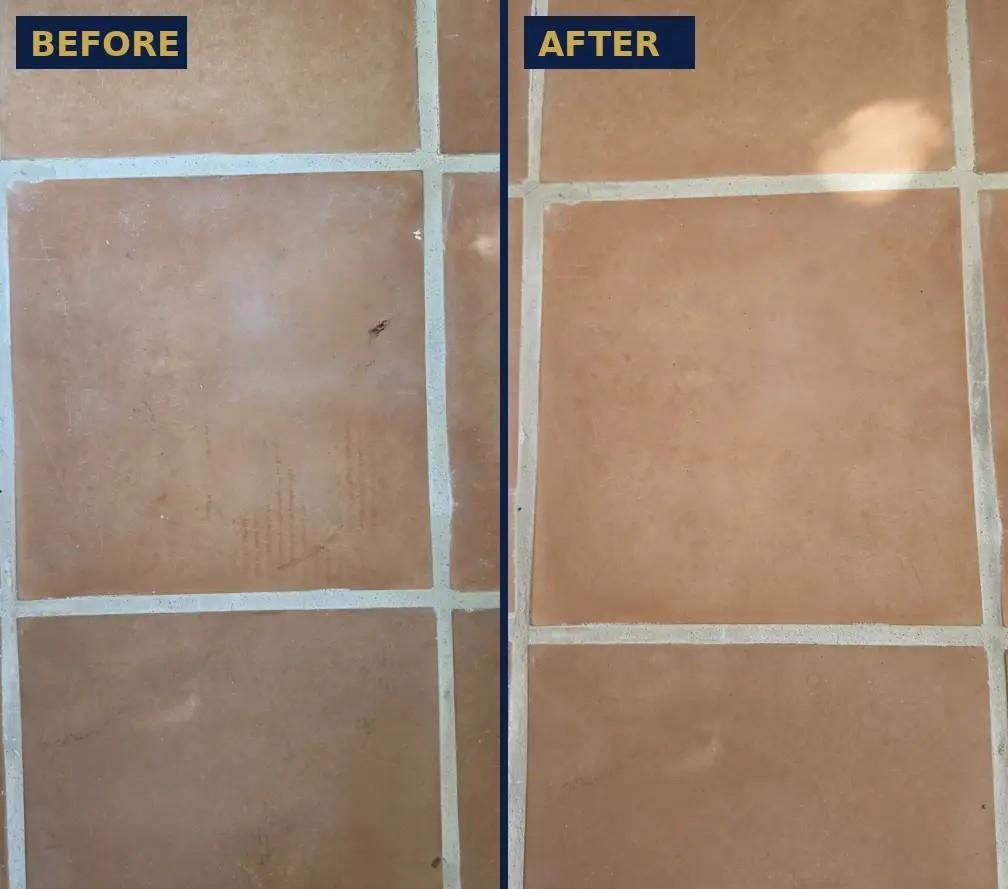
The haze part of this job is the same problem we correct on new tile installs every week. Our grout haze removal in Miami Beach page explains it, and so does our guide to telling grout haze from dirty grout.
Where We Restore Terracotta and Saltillo
We work on clay floors across Miami-Dade County and the Florida Keys, including Miami Beach, Coral Gables, Pinecrest, Key Biscayne, Coconut Grove, Kendall, Brickell, Sunny Isles Beach, Aventura, Key Largo and the rest of the Florida Keys. Every clay floor starts with a $250 on-site assessment, credited in full toward the work, because the right plan depends on what the floor actually is.
Frequently Asked Questions
Is saltillo the same as terracotta?
Saltillo is a type of terracotta, but not all terracotta is saltillo. Terracotta is the broad category of clay tile and can be made anywhere. Saltillo is handmade, sun-dried clay tile that comes only from the area around Saltillo, Mexico.
How can I tell if my floor is saltillo or terracotta?
Look at the shape, the color and the grout. Machine-made terracotta is usually smooth and flat, one even reddish brown, with tiles that are all the same size and thin grout lines. Saltillo has wavy surfaces, bumpy edges, blends of peach, yellow and red, slightly different tile sizes, and thick grout lines.
Do paw prints in the tile mean it is saltillo?
Very often, yes. Saltillo is dried outside in the sun, so dog paw prints, bird tracks and leaf imprints get baked right into the tile. Machine-made terracotta does not have them.
Are saltillo and terracotta cleaned the same way?
The everyday cleaning chemistry is the same, because both are raw clay. The difference is that saltillo is much more porous than machine-made terracotta, so it needs maintenance more often.
Why does my clay tile floor look yellow or brown?
Usually it is not the tile. Layers of wax and acrylic applied over the years without ever being stripped oxidize into a yellow-brown haze, and in South Florida humidity gets trapped under them. Once those layers are stripped, the clay underneath is usually the same color it always was.
Can rust stains, paint and haze come off terracotta tile?
On this Miami Beach floor we removed rust streaks, paint splatter and cement haze with low-moisture work, chemistry plus controlled extraction, then applied a transparent sealer. Every clay floor is different, so we assess it in person before we plan the work.
Do you restore terracotta and saltillo floors in Miami-Dade and the Florida Keys?
Yes. Keep It Clean Tile and Grout restores terracotta and saltillo floors across Miami-Dade County and the Florida Keys, including Miami Beach, Coral Gables, Pinecrest, Key Biscayne and Key Largo. The $250 on-site assessment is credited in full toward the work. Call or text 305-741-9729.
Not Sure Which Clay Floor You Have?
Keep It Clean Tile and Grout restores terracotta, saltillo and natural stone across Miami-Dade County and the Florida Keys.
Veteran-Owned | 25+ Years | 185+ Five-Star Reviews
★★★★★ Read our reviews on Google
The $250 assessment is credited in full toward your service.
Call or text: 305-741-9729
Always Local. Always On Time. Always Honest.