
Veteran-Owned | 25+ Years | 185+ Five-Star Reviews
Countertop and Vanity Restoration in Coral Gables
Coral Gables kitchens and baths are full of stone that was specified for how it looks, not for how it survives daily use. Marble, travertine, and limestone counters and vanity tops are calcium-based, which means they are chemically reactive. A squeezed lime, a splash of red wine, a bottle of bathroom cleaner set down on a vanity for ten seconds, and the polish is gone in that spot. The stone is not dirty and it is not stained. It is etched, and etching is a physical change in the surface that no cleaner will ever correct.
Keep It Clean restores stone that is already installed. We hone, polish, seal, and remove etch damage and staining on marble, travertine, and limestone countertops and vanity tops throughout Coral Gables. We are a restoration company, not a fabricator. If your slab is cracked through or a seam has failed, that is a fabrication and installation problem, and we will tell you that during the assessment instead of taking the job.
Short answer
Can dull or etched marble countertops in Coral Gables be restored?
Usually, yes. Dull rings and spots on marble are etching, a change in the surface itself, so no cleaner removes them. We hone the damaged layer off with diamond abrasives and water, polish back to the finish you want, draw stains out with a poultice, and seal with a penetrating impregnator. We do not fabricate, cut, or repair cracked slabs. The $250 assessment, credited in full toward the service, comes first.
Etching and Staining Are Not the Same Problem
They look similar to a homeowner and they get completely different treatments, so this is worth understanding before anyone touches your counter.
Etching is corrosion. Acid dissolves the calcium carbonate at the stone surface and leaves a dull, slightly rough patch that catches light differently than the stone around it. Coffee rings, citrus, vinegar, wine, tomato, most bathroom disinfectants, and a surprising number of products marketed as natural or gentle all do it. Staining is absorption. A liquid works into the pore structure and darkens the stone from within. Cooking oil, grease, cosmetics, hair product, and standing water leave stains, not etches.
You can tell them apart yourself. An etch is lighter than the surrounding stone, nearly disappears when you look straight down at it, and jumps out when you look across the surface at a low angle. A stain is darker than the stone around it and looks the same from every angle. Etches are corrected mechanically, by removing the damaged crystal layer. Stains are drawn back out chemically with a poultice. Treating one as though it were the other wastes time, and on marble it can make the surface worse.
Older Coral Gables homes add a third variable. A lot of the marble and limestone in and around the Village and the Biltmore neighborhood has been in place for decades, and somewhere along the way it was waxed, topically polished, or coated by a previous vendor. Those layers have to come off before any real correction begins, or the work is just polishing product instead of stone. The same principle drives our marble polishing work in Coral Gables on floors.
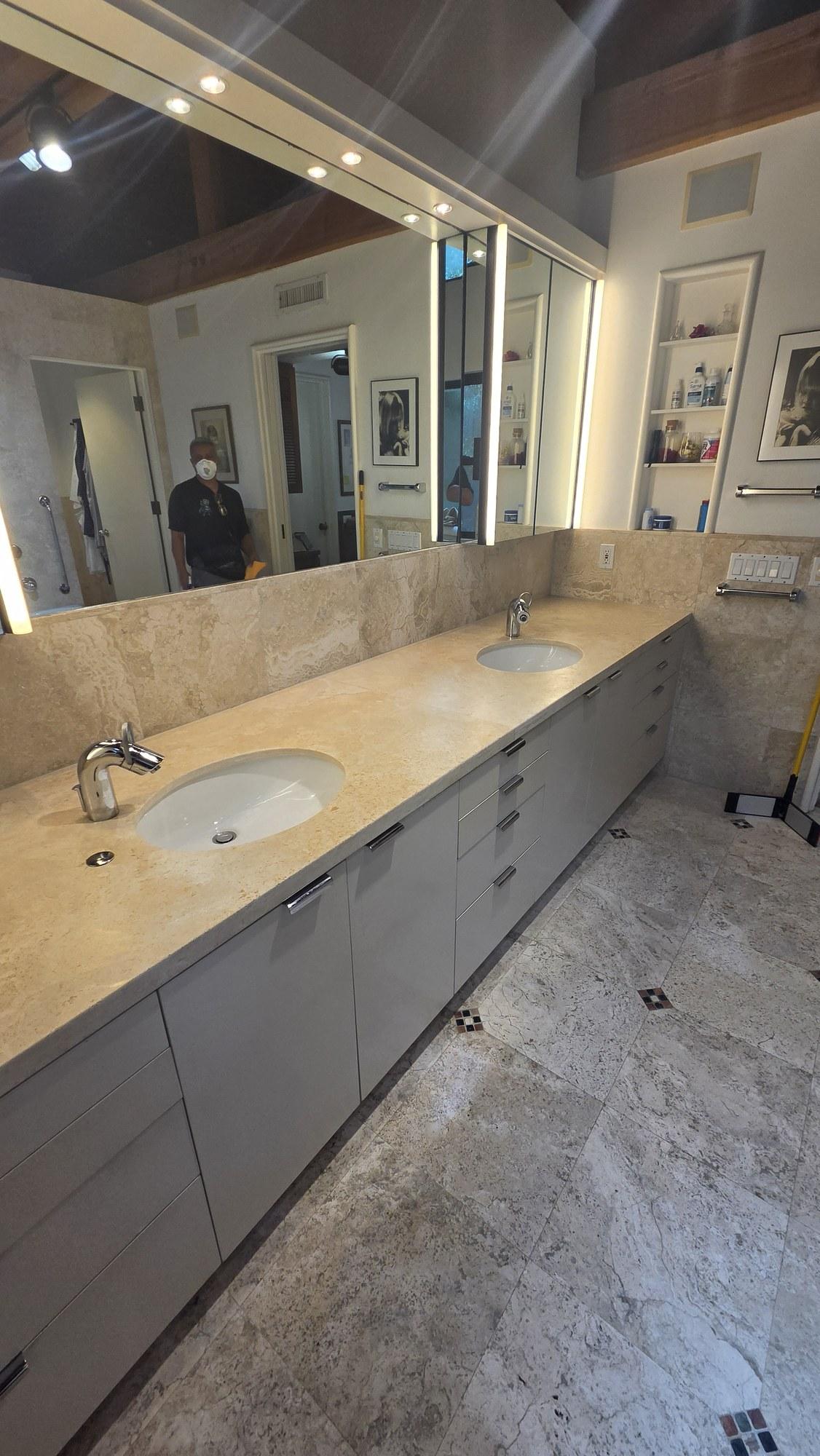
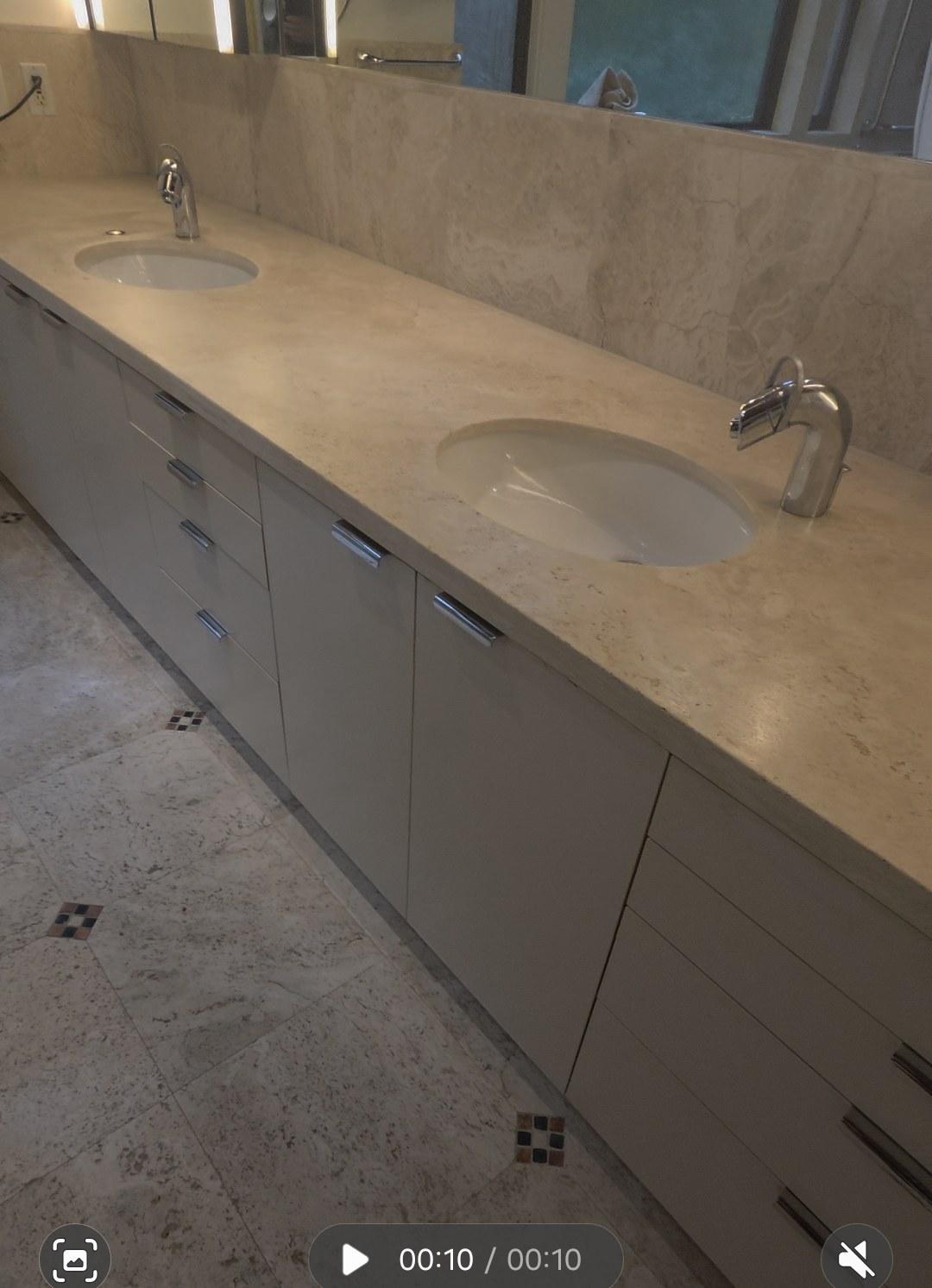
What We Restore, and What We Do Not Touch
We work on stone that is already installed and structurally sound. That covers:
- Honing to a consistent matte or satin finish, the same correction sequence behind our marble restoration work across Miami
- Polishing back to a factory-level gloss using diamond abrasives and water
- Etch removal on marble, travertine, and limestone counters and vanity tops
- Stain drawdown using poultice work
- Filling and refinishing open pitting and small surface voids in travertine and limestone tops
- Penetrating sealer application for kitchen counters, islands, and bathroom vanity tops
We do not fabricate stone. We do not cut or template new tops. We do not repair or re-run seams, and we do not perform structural repair on cracked slabs. Those are fabrication and installation trades with different equipment and different liability, and doing them badly is expensive for you. If that is what your counter actually needs, we will say so at the assessment and point you in the right direction rather than charge you for an attempt we should not be making.
If your project is travertine rather than marble, the surface behaves differently under abrasives and the filling step matters more. Our travertine restoration process in Coral Gables covers that in more detail.
How Countertop and Vanity Top Restoration Actually Works
Stage 1, assessment. We read the surface under raking light to separate etching from staining from old coating, identify the existing finish level, and test an inconspicuous area. On a single vanity top that takes a few minutes. On a large island plus a run of perimeter counter it takes longer, because different zones age at different rates. The stone around the sink and the cooktop is almost always further gone than the rest of the run, and matching those zones back together is most of the skill in the job.
Stage 2, coating and residue removal. If there is wax, topical polish, or a failed coating sitting on the stone, it comes off before anything else. Skipping this is why so many counters look worse a month after somebody polished them.
Stage 3, honing. Diamond abrasives and water, stepped through progressive grits, remove the chemically damaged crystal layer and bring the entire top to one consistent surface. This is the step that removes etching. There is no bottled product that does it, on any stone, at any price.
Stage 4, polishing. We step up through finer grits to the finish you want, whether that is matte, satin, or full polish. Holding one sheen across an L-shaped counter, a separate island, and a backsplash return is a matter of consistent pressure and consistent overlap, not chemistry. This is where uneven work shows itself under Coral Gables kitchen lighting.
Stage 5, sealing. Once the surface is correct and fully dry, we apply a penetrating impregnator that sits below the surface and slows absorption. We do not put topical coatings on countertops. They look right for a season, then they scratch, cloud, and peel, and stripping them off later costs more than the original restoration did.
The whole process is low moisture and stone-safe. Water and abrasives do the cutting. No acids, no high pressure, and no steam anywhere near your stone.
Watch: Polished Marble Counter, Before and After
Most people call us to bring the shine back. This Coral Gables client wanted it gone, across every counter in the house. What you are watching is stage four and the finished result: diamond abrasives on a variable speed polisher working a polished marble top down to a flat, even matte, then the completed vanity with the reflection gone.
Nothing is being stripped and nothing is being laid on top. Polished and honed are the same stone worked to a different grit, which is why the finish can go in either direction. A penetrating sealer goes down at the end so the stone is protected without the sheen coming back.
There was nothing wrong with this stone. That is worth saying plainly, because people assume stone restoration always starts with damage. The homeowner chose the polished finish herself years ago, lived with it, and decided she was done with it. That is a legitimate reason to call a stone company, and it is the part most people never consider. Taste is reversible on natural stone. You are not stuck with a decision you made years ago. If you are weighing the two finishes for your own home, our guide to honed vs. polished marble walks through which one fits each room. We went on to restore the Saltillo in the same home, one of the oldest houses in Coral Gables.
Sealing Kitchen and Bathroom Countertops
Sealing is worth doing in South Florida, and it is also widely oversold. Here is the honest version. A penetrating sealer buys you time. It slows a spill from becoming a stain long enough for you to notice it and wipe it up. That is genuinely valuable on a kitchen counter that sees olive oil and red wine every week.
What sealing does not do is stop etching. Etching is a chemical attack on the stone itself, and nothing that soaks into the pores prevents an acid from reaching the calcium at the surface. If a company tells you their sealer makes marble etch-proof, they are selling you a story. Sealed marble still etches. It just stains less.
There is no fixed schedule. It is always up to the client and how the stone is used: a kitchen counter that sees oil and wine every day, a vanity top that takes hairspray, perfume, nail products, and cleaners, and the products used to wipe them down decide when resealing comes due. Honed and textured finishes are more absorbent than polished ones and come due sooner. We test your stone during the assessment and tell you where it actually sits rather than putting every client on the same calendar.
Trusted Across Miami-Dade and Monroe County | 185+ 5-Star Reviews
★★★★★
"Honest, technical, and extremely detailed."
Coral Gables Homeowner
★★★★★
"Finally found a company that understands stone restoration."
Pinecrest Homeowner
Our reviews come from real Miami-Dade and Monroe County homeowners and property managers. You can read them directly on our Google Business Profile.
Rated ★★★★★ on Google
Frequently Asked Questions, Countertop and Vanity Restoration in Coral Gables
Can you fix the dull spots on my marble countertop?
In almost every case, yes. Dull spots on marble are etch marks, and etching is corrected by honing and repolishing the surface, not by applying a product. We remove the damaged layer with diamond abrasives and water, then bring the finish back to match the rest of the top. The stone remains marble afterward, so it can etch again if acid reaches it again.
What is the difference between an etch and a stain?
An etch is lighter than the surrounding stone, feels slightly rough, and is most visible when you look across the surface at a low angle. It is chemical corrosion of the stone itself. A stain is darker than the surrounding stone, looks the same from every angle, and is a substance absorbed into the pores. Etches are corrected mechanically. Stains are pulled out with a poultice. Most countertops we assess in Coral Gables have both.
Can you polish a travertine or limestone vanity top?
Yes. Both are calcium-based and both respond to the same honing and polishing sequence as marble, with one difference. Travertine and limestone have natural voids and pitting that open up as the surface is cut, so filling and refinishing those voids becomes part of the job. We assess how heavily filled the top already is before quoting the work, because a heavily filled travertine top behaves differently under abrasives than a dense one.
My housekeeper used the wrong product and now the counter is cloudy. Is that fixable?
Usually, yes, and this is one of the most common calls we get. Cloudiness is normally one of two things: widespread light etching from an acidic or abrasive cleaner, or a haze of built-up residue from a product that was never meant for natural stone. The first is corrected by honing and polishing. The second is stripped off. We identify which one you have at the assessment before doing anything.
Do you seal kitchen countertops, and how long does it last?
Yes, we apply penetrating impregnating sealers to kitchen counters, islands, and bathroom vanity tops. There is no fixed schedule. It is always up to the client and how the counter is used and cleaned, and honed or textured finishes come due sooner than polished ones. Sealing reduces staining. It does not prevent etching, and any company that tells you otherwise is overselling.
Can you repair a crack in my countertop or fix a bad seam?
No. Cracked slabs and failed seams are fabrication and installation work, not restoration, and we do not take that work on. If we find a crack or a seam issue during your assessment, we will tell you plainly and recommend you bring in a fabricator. We would rather lose the job than attempt something outside what we do well.
How long does a countertop restoration take?
A single vanity top is usually a few hours. A full kitchen with an island and a perimeter run is typically a full day, sometimes longer if there is heavy coating removal or extensive staining to draw out first. We give you a realistic window after the assessment, not before, because the condition of the stone drives the timeline.
Why is there a $250 assessment before any work?
Because stone restoration cannot be priced accurately over the phone or from a photo. The $250 assessment is credited in full toward your service. The assessment is where we test the surface, separate etching from staining from coating, and tell you exactly what your stone needs and what it will cost. You get a real answer instead of a number someone guessed at.
Ready to Restore Your Countertops in Coral Gables?
If your marble has dull rings you cannot clean off, your vanity top has gone cloudy, or your travertine counter is pitting and holding dirt, this is the call to make.
Reserve your $250 assessment, paid via Zelle to confirm your appointment, credited in full toward your service.
Countertop and vanity restoration carries an $800 job minimum.
Call or text: 305-741-9729
Always Local - Always On Time - Always Honest.