Keep It CleanTile and Grout
SuperHero Header

Request Your Assessment

This site is protected by reCAPTCHA and the Google Privacy Policy and Terms of Service apply.

Grout Color Sealing in Pinecrest

Grout Color Sealing in Pinecrest

Case Study | Pinecrest

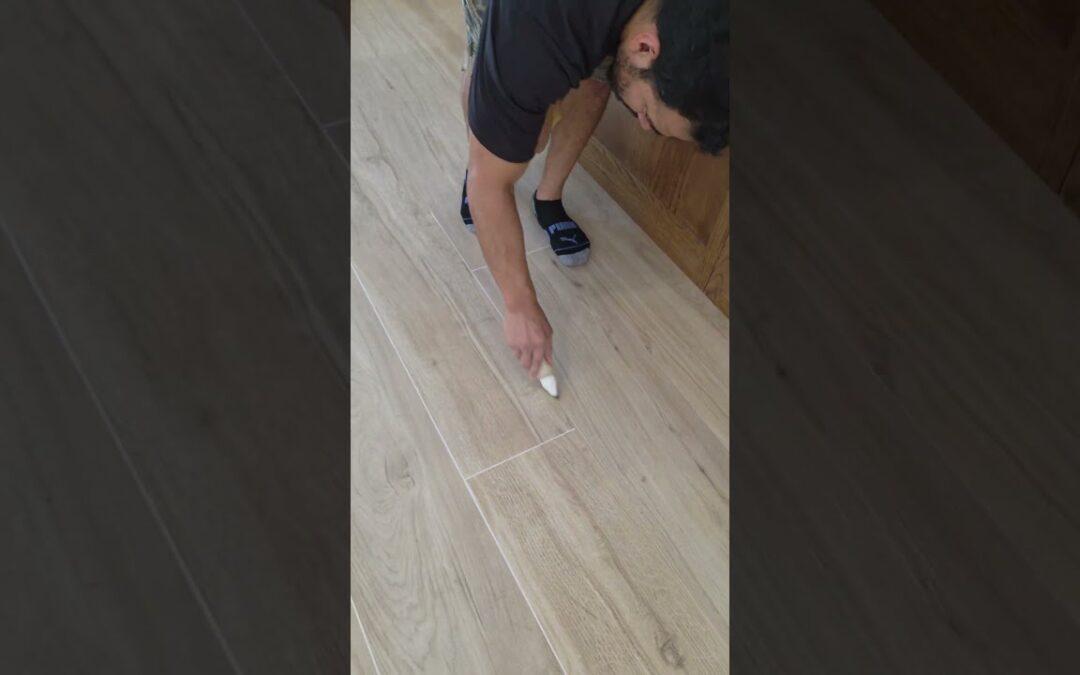
Grout color sealing in Pinecrest was the call for new owners who walked into stark white grout against wood-look tile. It was not their style at all. Instead of ripping out the floor, we color-matched the grout directly into the tile. No demo, no new flooring.
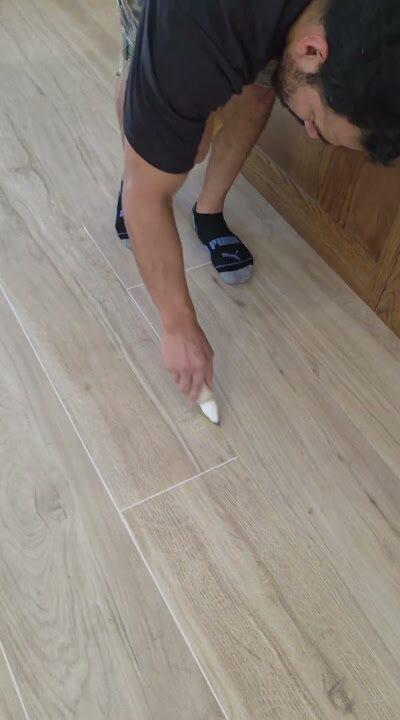
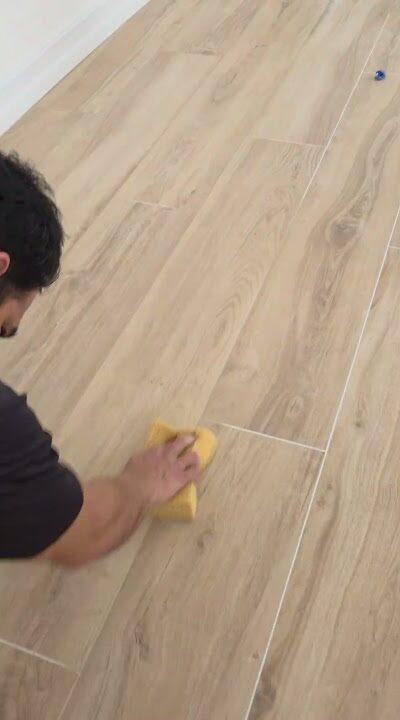
Crew applying grout color sealer to white grout on wood-look tile in a Pinecrest home
THE WORK
Wiping down wood-look tile during grout color sealing in Pinecrest
DETAIL

The Job at a Glance

5
days on the job
4
on the crew: Miguel, Javi, Franco and Gian
0
tiles replaced, no demo
Empty
home, this job needs a vacant space

Pinecrest | Wood-look tile | Grout color sealing

STEP 1 OF 3

What We Found

The tile itself was fine. The problem was the look: bright white grout lines cutting across a wood-look floor, so every joint stood out. The new owners did not want to live with it, and they did not want to tear out a floor that was otherwise in good shape.

The grout color can be changed without replacing the tile. Grout color sealing recolors the existing grout lines to match or contrast with the tile, without touching the tile itself.

Watch the job | 53 seconds

STEP 2 OF 3

What We Did

Miguel, Javi, Franco and Gian worked this floor over 5 days.

1Clean. The grout was deep cleaned before anything was applied. Otherwise you seal the soil in.
2Match. The grout color was matched to the wood-look tile, so the joints disappear into the floor instead of cutting across it.
3Color seal. A pigmented sealer was bonded into the grout lines, without touching the tile. See our grout refresh and color sealing.

STEP 3 OF 3

Color Sealing Is Not Painting the Grout

Paint sits on top of the grout and wears off. Color sealing bonds a pigmented sealer into the grout itself. Because the grout is recolored, you can go either direction: take stark white down to something that disappears into the tile, or go the other way for contrast.

It costs a fraction of what a floor replacement does, and the tile you already paid for stays where it is.

Change the grout. Keep the floor.

Already Living There?

This job needs an empty space, so it is done on vacant homes, new listings, or between move-out and move-in. If you are still living there, a short-term portable storage rental clears the room enough to get it done.

Grout Color Sealing: Questions People Ask Us

Can grout color be changed without replacing the tile?

Yes. Grout color sealing recolors the existing grout lines to match or contrast with the tile, without touching the tile itself.

Is grout color sealing the same as painting the grout?

No. Paint sits on top and wears off. Color sealing bonds a pigmented sealer into the grout itself.

Can you go darker and lighter, or only darker?

Both. The grout is recolored, so you can take stark white down to something that disappears into the tile, or go the other direction for contrast.

Does the tile have to be cleaned first?

Yes. The grout is deep cleaned before anything is applied, otherwise you seal the soil in.

Grout You Cannot Stand in Pinecrest?

Text a photo of the floor to 305-741-9729. Every job begins with a $250 assessment, credited in full toward your service.

See our grout refresh and color sealing in Miami, more on tile and grout cleaning in Pinecrest, or the pool deck and Saltillo case studies.

Veteran-Owned | 25+ Years | 185+ Five-Star Reviews

Grout Haze Removal and Tile Cleaning in Miami Lakes

Grout Haze Removal and Tile Cleaning in Miami Lakes

Case Study | Miami Lakes

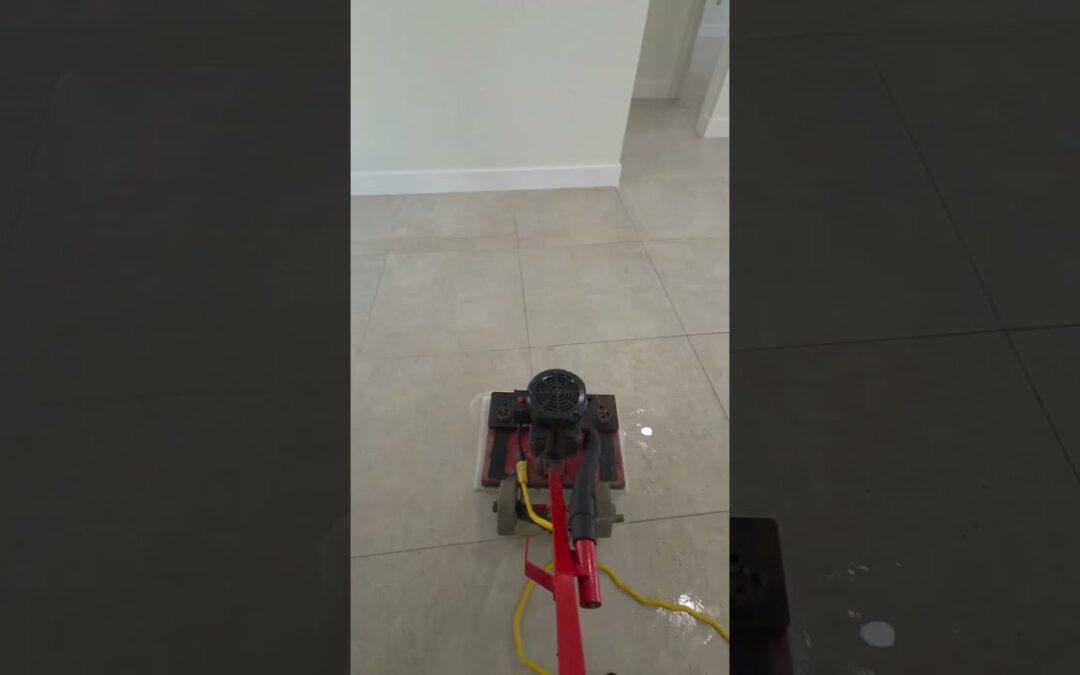
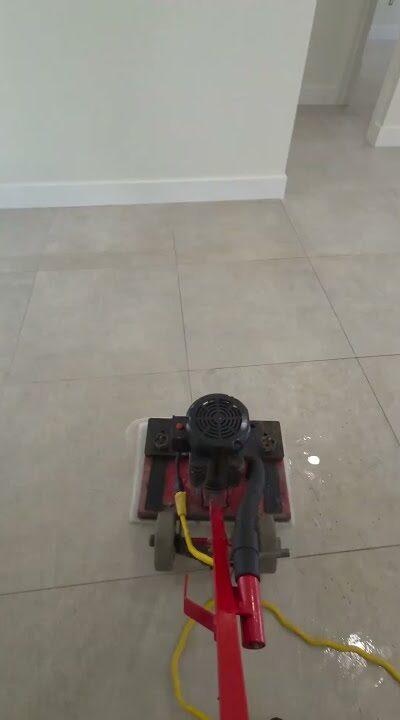
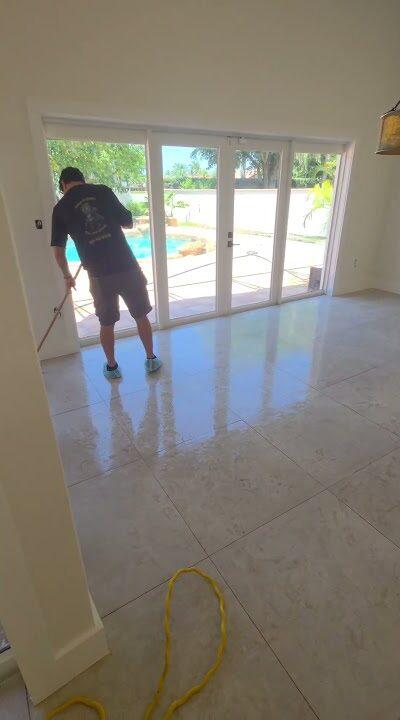
Grout haze removal and tile cleaning in Miami Lakes were two separate jobs on one floor, in a newly purchased home that sat empty before move-in. The new owner saw a dull, patchy floor across the large-format concrete-look porcelain and assumed it was dirty or worn out. The two problems do not have the same fix.

Cleaning machine on large-format porcelain tile in an empty Miami Lakes home
THE WORK
Crew working on porcelain tile near the patio doors in a Miami Lakes home
ON SITE

The Job at a Glance

5
hours, start to finish
2
on the crew, Miguel and Javi
2
problems on one floor: soil and haze
Empty
home, done before move-in

Miami Lakes | Large-format porcelain | Low moisture

STEP 1 OF 3

What We Found

Problem 1: soil in the grout. Embedded soil down in the grout lines. That is a cleaning problem, and controlled extraction handles it.
Problem 2: haze on the tile. A thin cement film left behind when installation residue was never fully washed off. It bonds to the surface. That is a chemistry problem, and no amount of cleaning removes it.

The previous owner most likely spent years assuming the cloudiness was simply how the floor looked. Matte porcelain like this holds haze worse than polished, because the surface texture gives the film something to grip.

Watch the job | 31 seconds

STEP 2 OF 3

What We Did

Miguel and Javi did this one together, in about 5 hours. Low moisture throughout: chemistry plus controlled extraction, no high pressure, no steam.

1Clean. Tile and grout cleaning first, with controlled extraction pulling the soil out of the grout lines.
2Identify. With the floor clean, the haze could finally be seen for what it was.
3Remove the haze. Chemistry matched to the haze on this porcelain. See our grout haze removal in Miami.

STEP 3 OF 3

Why the Order Matters

Sequence is the part that gets missed. You clean first, because you cannot judge how much haze is present while soil is still sitting on top of it. Only once the floor is clean can the haze be identified and matched to the right chemistry.

Reverse that order and you are guessing. Guessing on the face of a tile is how floors get damaged.

Clean first. Then you can see the haze.

Just Bought a Home?

If you are not sure what you inherited, deal with it while the rooms are still empty. It goes faster, it costs less, and you will never have better access to the floor than before the furniture arrives.

Grout Haze: Questions People Ask Us

What is grout haze?

A thin cement film left on the face of the tile when installation residue was never fully washed off. It bonds to the surface, so it is not dirt.

Can regular cleaning remove grout haze?

No. Haze is a chemistry problem. Cleaning handles the soil in the grout, but the haze needs chemistry matched to it.

Why does my porcelain floor look dull and patchy?

It can be soil in the grout, haze on the tile, or both at once, like this Miami Lakes floor. We clean first so we can see which one you have.

Does matte porcelain hold haze more than polished?

Yes. The surface texture of matte porcelain gives the film something to grip.

Cloudy or Patchy Tile in Miami Lakes?

Text a photo of the floor to 305-741-9729 and we will tell you whether it is soil, haze or both. Every job begins with a $250 assessment, credited in full toward your service.

See our tile and grout cleaning in Miami and grout haze removal in Miami, or read the rust stain, acrylic sealer and terrazzo case studies.

Veteran-Owned | 25+ Years | 185+ Five-Star Reviews

Terrazzo Floor Restoration in Cutler Bay

Terrazzo Floor Restoration in Cutler Bay

Case Study | Cutler Bay

Terrazzo floor restoration in Cutler Bay took 5 days on this home, where deep scratches, worn spots and years of dullness were past anything regular cleaning could fix. It needed real correction, not a mop and a coat of wax. Here is how the floor came back, and why there is no acrylic coating on it.

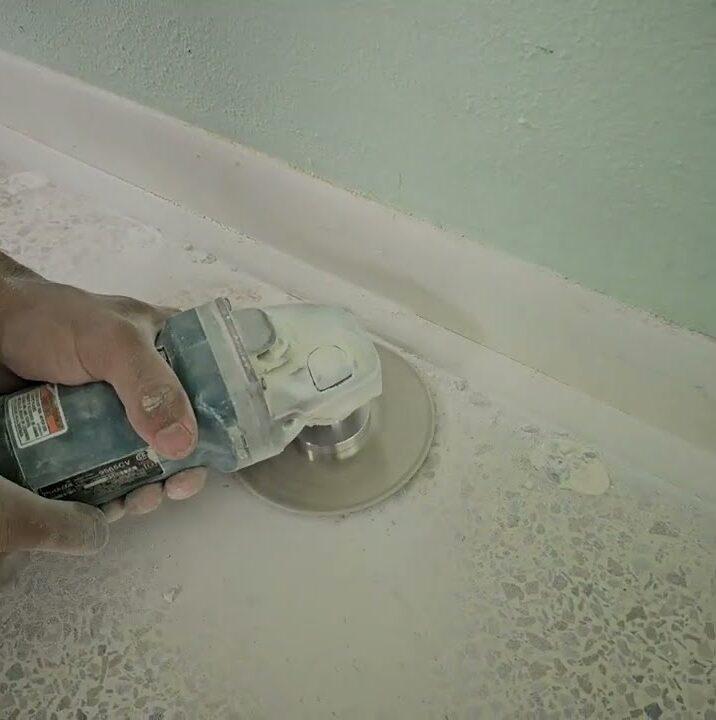
Grinding the edge of a terrazzo floor along the baseboard in Cutler Bay
THE WORK
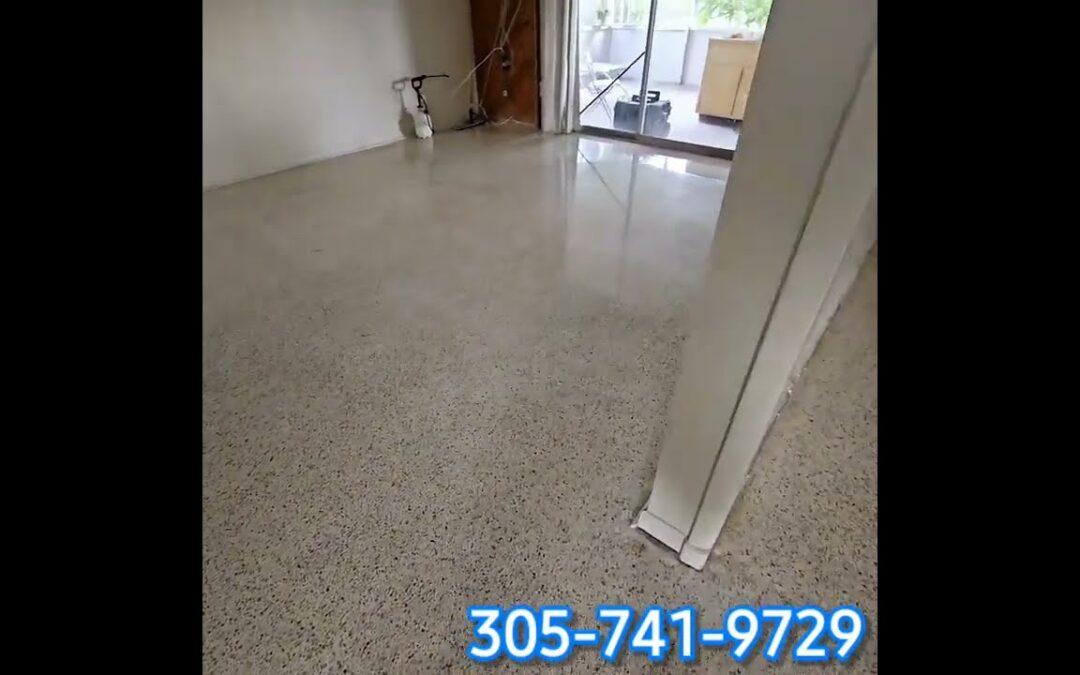
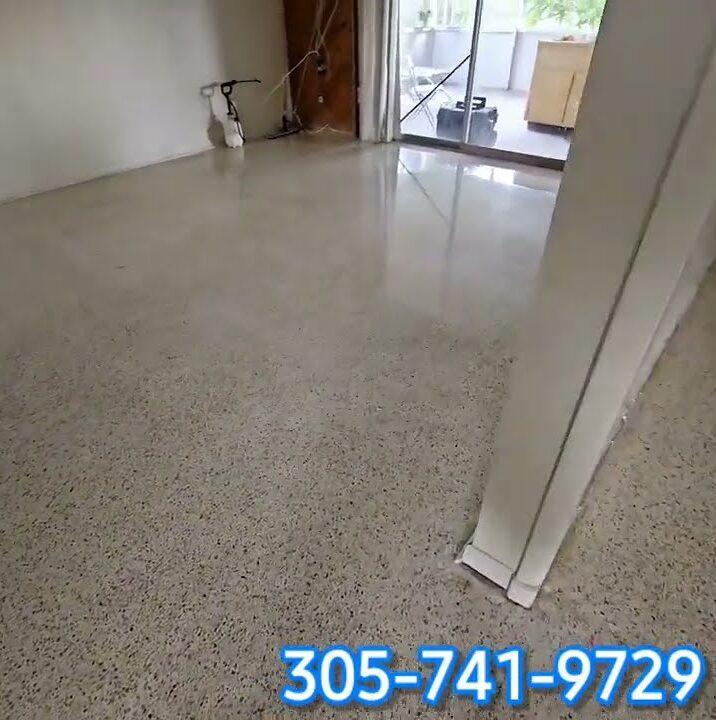
Terrazzo floor in a Cutler Bay home after honing, polishing and sealing
AFTER

The Job at a Glance

5
days on the job
2
on the crew, Miguel and José
4
stages: hone, repair, polish, seal
0
acrylic coatings or wax

Cutler Bay | Residential terrazzo | Penetrating sealer

STEP 1 OF 3

What We Found

The floor showed visible surface wear, deep scratches, and years of dullness. That kind of damage lives in the surface of the terrazzo itself, so no amount of mopping or cleaning product was going to bring it back.

There were also cracks and chips that had to be repaired before any polishing, or they would have stayed in the finished floor.

Watch the job | 3 minutes

STEP 2 OF 3

What We Did

Miguel and José worked this floor over 5 days, in four stages.

1Hone. Diamond honing took off the damaged surface layer and exposed clean aggregate.
2Repair. Cracks and chips were patched with color-matched matrix.
3Polish. Progressive polishing, step by step, so the shine comes from the stone itself.
4Seal. A breathable penetrating sealer, with no film-forming coating on top.
Slurry on a terrazzo floor during diamond honing in Cutler Bay
HONING

STEP 3 OF 3

Why There Is No Acrylic on This Floor

We did not put wax or acrylic on this floor. No acrylic coatings, no shortcuts, no temporary treatments. The floor was corrected mechanically, then sealed with a breathable penetrating sealer that goes into the stone instead of sitting on top of it.

If you want to see what a failing acrylic looks like on a floor, read our acrylic sealer case study, also in Cutler Bay.

The shine comes from the stone, not from a coating on top of it.

What the Client Said

★★★★★

"Very happy with everything."

ResponsivenessPunctualityQualityProfessionalismValue

Joel R. | Google review

Terrazzo Restoration: Questions People Ask Us

Can a scratched terrazzo floor be fixed without replacing it?

On this Cutler Bay floor, yes. Diamond honing took off the damaged surface layer, and progressive polishing brought the finish back from the stone itself.

Can you repair cracks and chips in terrazzo?

Yes. We patch them with color-matched matrix before polishing, so the repair is part of the finished floor.

Why not just wax or coat the terrazzo?

Wax and acrylic sit on top of the floor. We correct the stone mechanically and finish with a breathable penetrating sealer, with no film-forming coating on top.

How long does a terrazzo restoration take?

This one took 5 days with a two-person crew. Every floor is different, so we tell you at the assessment.

Dull or Scratched Terrazzo in Cutler Bay?

Text a photo of the floor to 305-741-9729. Every terrazzo job begins with a $250 assessment, credited in full toward your service.

See our terrazzo restoration in Miami, more jobs on our tile and grout cleaning in Cutler Bay page, or the rust stain case study.

Veteran-Owned | 25+ Years | 185+ Five-Star Reviews

Acrylic Sealer Removal and Ceramic Coating in Cutler Bay

Acrylic Sealer Removal and Ceramic Coating in Cutler Bay

Case Study | Cutler Bay

Acrylic sealer removal came first on this Cutler Bay porcelain floor, because the coating someone had put down was failing and ripping apart. The tile came from Spain, so the owner called it Spanish tile, but it is porcelain. Here is why we stripped it instead of cleaning over it, and why porcelain gets a coating at all.

Failing acrylic sealer on a porcelain tile floor in Cutler Bay, before stripping
BEFORE

What the sealer was doing

Hazing over

Building up along the edges

Wearing through in the walking paths

Ripping apart

The Job at a Glance

6
hours, start to finish
2
on the crew, Miguel and Franco
Bare
tile, acrylic stripped before anything else
5★
Google review from the owner

Cutler Bay | Porcelain tile made in Spain | Ceramic coating

STEP 1 OF 3

What We Found

The floor had the wrong product on it. An acrylic coating had been applied over the porcelain, and in this climate it was not holding. It had hazed over, built up along the edges and corners, worn through where people walk, and in places it was ripping apart.

A floor in that condition cannot be cleaned back. Scrubbing over a failing acrylic just seals the problem in underneath it. The coating had to come off first.

Watch the job | 1 minute

STEP 2 OF 3

What We Did

Miguel and Franco did this one together, and it took about 6 hours from start to finish.

1Strip. We took the acrylic off, down to bare tile.
2Clean. We deep cleaned the tile and grout, then let the floor dry.
3Coat. We applied a ceramic floor coating over the clean, dry porcelain.

STEP 3 OF 3

Why Porcelain Gets a Coating

Porcelain is dense. It cannot be honed or polished the way natural stone can, so a coating is how you change its finish. The ceramic coating we use is one part and silane based, and it is rated for tile and grout, concrete, masonry, epoxy, natural stone, VCT, LVT and LVP.

Stone is a different story. On marble, travertine, limestone and Saltillo in South Florida, we refinish the stone and use a penetrating sealer, so the stone can still release moisture.

The right product for the surface matters more than how hard you scrub.

What the Client Said

★★★★★

George P. | 5-star Google review

Failing Sealers: Questions People Ask Us

How do I know if my floor has a coating on it?

It usually shows as an uneven sheen, cloudiness, or buildup along the edges and corners. A shine that looks patchy is often a coating rather than the tile itself.

Can you clean over an old acrylic sealer?

No. Cleaning on top of a failing coating traps the problem underneath it. The coating has to be stripped first.

Why do acrylic sealers fail in South Florida?

Acrylic is a common choice, and it does not hold up well to South Florida humidity and foot traffic.

Hazy or Peeling Sealer on Your Floor in Cutler Bay?

Text a photo of the floor to 305-741-9729 and we will tell you whether it is the tile or a coating on top of it. Every job begins with a $250 assessment, credited in full toward your service.

More real jobs on our tile and grout cleaning in Cutler Bay page, or read our rust stain and terrazzo case studies.

Veteran-Owned | 25+ Years | 185+ Five-Star Reviews

Rust Stain Removal on Tile in Cutler Bay

Rust Stain Removal on Tile in Cutler Bay

Case Study | Cutler Bay

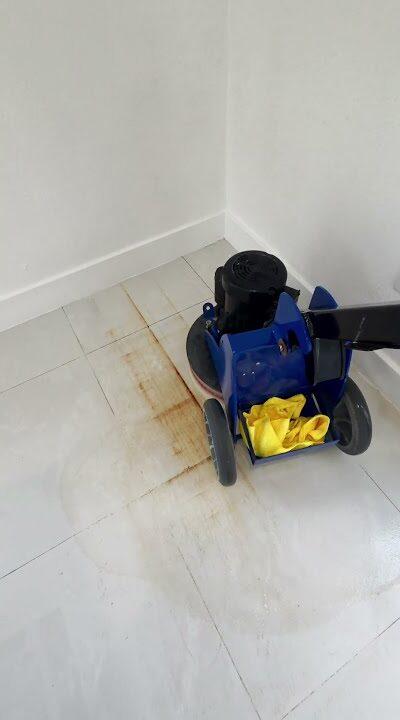
Rust stain removal on tile in Cutler Bay, after metal dog crates sat in the same spot on this floor for close to two years. The rust they left behind had gone deep into the tile. Here is how the job went, and why we told the owner to expect about 90 percent, not 100.

Rust stains from metal dog crates on a Cutler Bay tile floor, before the work
BEFORE
Machine working on rust stains on a Cutler Bay tile floor
THE WORK

The Job at a Glance

2
years, or close to it, under metal dog crates
30-45
minutes of work on the stains
90%
about that much of the staining removed
0
tiles replaced

Cutler Bay | Tile floor | Work by Miguel

STEP 1 OF 3

What We Found

This was not surface dirt, and it was not ordinary discoloration. Metal that sits in one place for months oxidizes, and the rust bonds into the surface of the tile. After close to two years under the crates, the staining had worked its way into the floor itself.

So the real question was not just how to clean it. It was how much of it the tile would give back.

Watch the job | 28 seconds

STEP 2 OF 3

What We Did

Miguel handled this one himself. He worked the stained areas with a rust and oxidation treatment, and the work on the stains took about 30 to 45 minutes. No tiles were pulled up and nothing was replaced.

STEP 3 OF 3

What Was Realistic

We removed roughly 90 percent of the staining. After years of rust, some shadowing can stay, because long exposure can change certain tile surfaces for good.

We give you the real number before we start, not after.

What the Client Said

★★★★★

"Miguel is fantastic. He did a great job cleaning my floor and went above and beyond. He is honest and that is rare to find, especially in Miami. Will use him again and will recommend him to anyone who needs this type of service."

Rebecca E. | Google review

Rust Stains on Tile: Questions People Ask Us

Can rust stains come out 100 percent after sitting for years?

Sometimes, but not always. Long-term rust exposure can change some tile surfaces for good, so we tell you what to expect before we start rather than overpromising.

What causes rust stains like this on tile?

Metal left in one place for a long time. Dog crates, furniture legs and appliances can oxidize and bond rust into the tile surface over months or years.

Do you have to replace the tile to fix rust damage?

Usually not. On this Cutler Bay floor we removed roughly 90 percent of the staining without replacing a single tile.

Rust or Stains on Your Tile in Cutler Bay?

Text a photo of the stain to 305-741-9729 and we will tell you what is realistic before we start. Every job begins with a $250 assessment, credited in full toward your service.

More real jobs on our tile and grout cleaning in Cutler Bay page, or read our acrylic sealer and terrazzo case studies.

Veteran-Owned | 25+ Years | 185+ Five-Star Reviews

Honed vs. Polished Marble in Miami: Which Finish Fits Each Room

Honed vs. Polished Marble in Miami: Which Finish Fits Each Room

Honed vs polished marble is one of the first questions on a marble job, and it comes down to this: do you want it to shine, or do you want it soft? Polished and honed are two finishes on the same stone, and in Miami the right one depends on the room, the water, and the sun. This guide covers which finish fits pool decks, bathrooms and kitchens, what to do about etching, and what sealing can and cannot do.

By Miguel Cedeno, owner of Keep It Clean Tile and Grout. Veteran-owned, 25+ years restoring tile and stone in Miami-Dade County and the Florida Keys.

Short answer: A polished finish has a glossy, mirror-like shine. A honed finish has a smooth matte or satin look that does not reflect light. In Miami, go honed anywhere the stone gets wet underfoot, like pool decks and bathroom floors. In kitchens it comes down to your habits. And whichever you choose, sealing stops stains, not etching.

Honed vs Polished Marble: What Is the Difference?

It is the same marble either way. What changes is how far the surface is taken. Polished stone is buffed until the surface pores are tightly compressed and practically closed, which is what gives it that mirror shine. Honed stone stops earlier, so it keeps a smooth, flat, matte or satin look with its pores left open.

That one difference drives almost everything else: grip, glare, how well the stone hides etching, and how much sealer it needs. You can see both finishes in our marble polishing work in Coral Gables.

At a glance Honed Polished
Look Smooth matte or satin, no reflection Glossy, mirror-like shine
Grip when wet Good grip Slippery, like ice
Etching and scratches Hides them better Shows dull spots and scratches
Food stains like wine or oil Absorbs faster Resists liquids better
Glare from big windows No glare Can glare
Pool decks and outdoors Recommended, and light colors stay cooler Not recommended, slick when wet
Surface pores Left open Tightly closed
Sealing Needs sealing more often Needs sealing less often
Honed vs polished marble: honed marble at a church we worked on, a matte finish with no reflection
Honed: matte, no reflection.
Polished marble at a church we worked on, a glossy finish that reflects the light
Polished: glossy, reflects the light.

Both finishes on marble at a church we worked on.

Which Finish for Each Room in Miami

Pool decks: always honed. Or a textured finish like tumbled or brushed. Polished stone turns into ice when it gets wet from rain or pool splashes. Light-colored honed stone also stays much cooler under the Miami sun.

Bathrooms: honed for floors, polished for walls. Honed floors give you grip so you do not slip stepping out of the shower, and they hide the water spots and condensation that come with Miami humidity. Polished looks great on walls, where nobody walks.

Kitchens: it is a tie, so choose based on your habits. Choose honed if you hate seeing scratches and dull spots from acidic foods like citrus or vinegar. It also cuts the glare from big windows. Choose polished if you worry more about food stains like wine or oil, because polished stone resists liquids better. For marble counters and vanities, see our countertop and vanity restoration page.

A Real Job: Polished Marble Taken to Honed in Coral Gables

Most people call us to bring the shine back. This Coral Gables homeowner wanted it gone, on every counter in the house. There was nothing wrong with the stone. She chose the polished finish years ago, lived with it, and decided she was done with it.

We used diamond abrasives on a variable speed polisher to work the polished tops down to a flat, even matte. Nothing was stripped and nothing was laid on top. Polished and honed are the same stone worked to a different grit, which is why the finish can go in either direction. A penetrating sealer went down at the end. Taste is reversible on natural stone, so you are not stuck with a finish you picked years ago.

Honed vs polished marble, before: polished marble countertop in Coral Gables with a glossy finish

Before: polished, glossy, reflecting the room.

Same marble countertop in Coral Gables after honing to a flat matte finish with no reflection

After: honed to a flat, even matte.

Watch the polished counter go matte, then see the full job on our countertop and vanity restoration in Coral Gables page.

Not sure which finish your marble has, or should have? We look at the stone in person, tell you whether it needs polishing, honing, or both, and walk you through it before any work begins. The $250 assessment is credited in full toward your service. Call or text 305-741-9729.

Etching: Do You Have to Switch to Honed?

No. Etching does not mean you have to change your marble to a matte look. Think of it like a scratch on a car.

Light etching is a minor smudge. It is a faint, cloudy mark, and the stone still feels perfectly smooth. Polishing alone fixes it. We buff it out with stone polishing powder and the shine comes right back.

Deep etching is a deep scratch. It is a rough, chalky or white spot you can feel with your fingernail. That spot has to be honed first, sanded flat, before it can be polished back to a shine.

The bottom line: if the etch mark feels smooth, it gets polished. If it feels rough, it gets honed and then polished. Our marble restoration in Miami page covers the full process. Travertine and limestone are calcium-based stones too, so they etch the same way. See travertine restoration in Miami and limestone restoration in Miami.

What Sealing Does, and What It Does Not

Sealing does not stop etching or scratching. A penetrating sealer is an invisible sponge, not a shield. It soaks into the stone to slow liquids like wine, oil and coffee from causing deep stains. It does nothing to protect the surface from acids like lime juice or vinegar, and it does nothing against scratches. Sealer stops stains, not chemical burns. Spill lemon juice on a sealed, polished marble counter and it will still leave a dull etch mark. The sealer only keeps that lemon juice from turning into a deep, permanent discoloration.

Honed stone needs more sealer than polished stone. Honed stone is thirsty and polished stone is full. With its pores left open, honed marble drinks up liquids and sealer faster, so it needs sealing more often. Polished marble resists liquids on its own because its surface is closed tight, so it needs sealing less often. How often either one needs it is always up to how the stone is used and treated, so there is no fixed schedule. We check it during the assessment. See our stone sealing in Miami page for more. If etching is your bigger worry, ask us about ceramic floor coating.

Frequently Asked Questions

What is the difference between honed and polished marble?

A polished finish has a glossy, mirror-like shine. A honed finish has a smooth matte or satin look that does not reflect light. It is the same stone either way. The difference is how far the surface is taken.

Is polished marble slippery?

When it gets wet, yes. Polished stone turns into ice from rain, pool splashes or a wet shower floor. That is why we recommend honed for pool decks and bathroom floors, and keep polished for walls and other surfaces nobody walks on.

Does etching mean my marble has to be changed to a honed finish?

No. If the etch mark still feels smooth, it is light etching and polishing alone brings the shine back. If you can feel a rough, chalky spot with your fingernail, it is deep etching. That spot has to be honed flat first, then polished back to a shine.

Does sealing marble stop etching?

No. A penetrating sealer is an invisible sponge, not a shield. It slows liquids like wine, oil and coffee from soaking in and staining. It does nothing to stop acids like lime juice or vinegar from etching the surface, and it does not stop scratches.

Does honed marble need more sealing than polished marble?

Yes. Honed stone is left with its pores open, so it absorbs liquids faster and needs sealing more often than polished stone, which is buffed until its surface pores are tightly closed. How often depends on how the stone is used and treated, so there is no fixed schedule. We check it during the assessment.

How much does marble honing or polishing cost in Miami?

A $250 assessment fee applies, paid via Zelle to confirm your appointment, credited in full toward your service. Final pricing depends on the square footage, the condition of the stone, and whether it needs polishing only or honing first.

Talk to Us About Your Marble

Keep It Clean Tile and Grout hones, polishes and seals marble and natural stone across Miami-Dade County and the Florida Keys, in homes and in commercial lobbies and businesses.

Veteran-Owned | 25+ Years | 185+ Five-Star Reviews
★★★★★ Read our reviews on Google

The $250 assessment is credited in full toward your service.

Call or text: 305-741-9729

Always Local. Always On Time. Always Honest.

Terracotta vs. Saltillo Tile: How Miami Homeowners Can Tell Them Apart

Terracotta vs. Saltillo Tile: How Miami Homeowners Can Tell Them Apart

Orange clay floors are all over Miami, from Coral Gables Mediterranean homes to Miami Beach condos and Keys houses, and most homeowners call every one of them saltillo. A lot of them are not, and terracotta vs saltillo is one of the first things we sort out on a clay floor. Knowing which one you have changes how often the floor needs care, and it changes what a restoration crew should plan before they ever start.

By Miguel Cedeno, owner of Keep It Clean Tile and Grout. Veteran-owned, 25+ years restoring tile and stone in Miami-Dade County and the Florida Keys.

Short answer: Terracotta is the broad category of clay tile. Saltillo is one specific kind of terracotta: handmade, sun-dried clay tile that comes only from the area around Saltillo, Mexico. Think of it like wine and Champagne. All Champagne is wine, but not all wine is Champagne. The everyday cleaning chemistry is the same for both, but saltillo is much more porous than machine-made terracotta, so it needs maintenance more often.

Terracotta vs Saltillo: How Do You Tell Them Apart?

Terracotta can be made anywhere in the world, in many styles, and it can be perfectly smooth and uniform. Saltillo is made in one place, the old-school way. Three things give it away.

  • The look. Machine-made terracotta is usually smooth, flat, and an even reddish brown. Saltillo is wild: wavy surfaces, bumpy edges, and blends of peach, yellow and red in the same floor.
  • The "flaws." Saltillo tiles are dried outside in the sun, so it is very common to find dog paw prints, bird tracks or leaf imprints baked right into the tile. Machine-made terracotta does not have these.
  • The fit. Machine-made terracotta tiles are all the same size. Saltillo tiles are handmade, so each one is a slightly different shape and size, which is why saltillo floors are laid with thick grout lines between them.
At a glance Machine-made terracotta Saltillo
Where it is made Anywhere in the world Only around Saltillo, Mexico
Surface Smooth and flat Wavy, bumpy edges
Color Even reddish brown Blends of peach, yellow and red
Marks None Paw prints, bird tracks, leaf imprints
Tile size All the same Slightly different, handmade
Grout lines Thin Thick
Porosity Less porous Much more porous
Maintenance Less often More often

What Stays the Same, and What Changes

Because saltillo is a specific type of terracotta, both are raw clay and both follow the same basic rules. The everyday cleaning chemistry is exactly the same.

The difference is porosity. Saltillo is much more porous than standard machine-made terracotta, so it takes in more of whatever lands on it and it needs maintenance more often. Treat a saltillo floor on a terracotta schedule and it falls behind. That is why we always look at a clay floor in person before we plan the work. Photos rarely tell the whole story.

Clay Floors and South Florida Humidity

What works on clay floors in South Florida only works in South Florida. Clay is raw and porous, and Miami humidity is always trying to move through it. When a floor gets buried under layers of wax or acrylic that were never stripped, that moisture gets trapped, and the old coating oxidizes into the yellow-brown haze people mistake for old tile. The clay underneath usually has not changed at all.

That is why the first step on a buried clay floor is usually chemistry to strip the old layers, and the last step is a finish that lets humidity escape instead of trapping it under the surface. On saltillo and terracotta alike, the goal is to protect the clay without burying it.

If your floor turns out to be saltillo, see our saltillo restoration in Miami page, or saltillo restoration in Coral Gables.

A Real Job: California Terracotta in Miami Beach

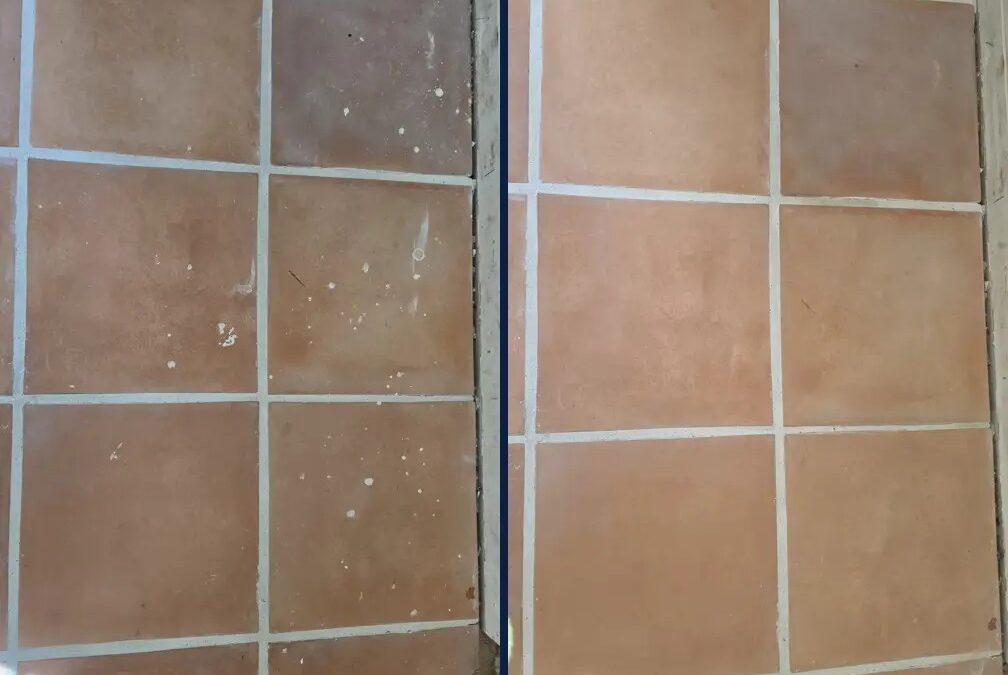
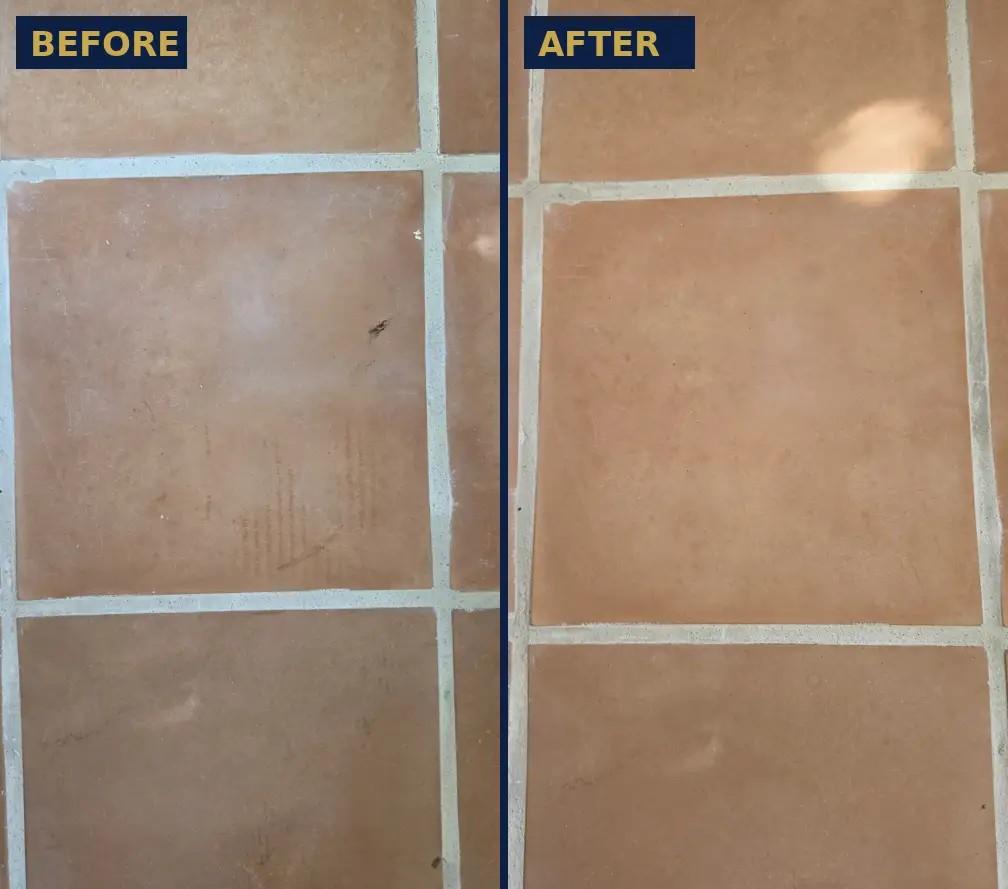
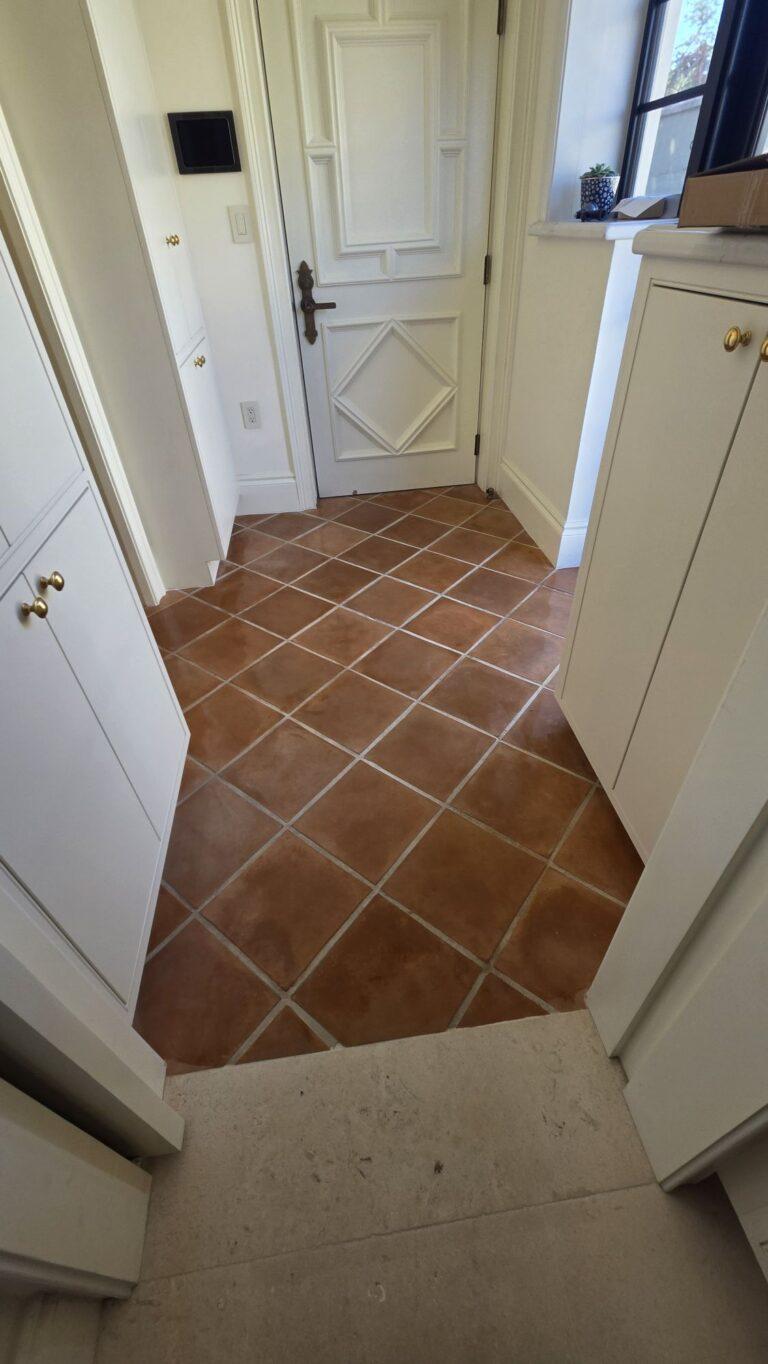
The floor in the before and after at the top of this page, in a Miami Beach home, looks like saltillo at a glance. It is not. It is 100% terracotta from California: uniform squares, sharp edges, even color, thin grout lines.

It came to us with rust streaks across several tiles, white paint splatter, and a white cement haze along the grout lines. The work was low-moisture from start to finish, chemistry plus controlled extraction, with no high pressure and no steam. We removed the rust, the paint and the haze, then finished with a transparent sealer so the clay keeps its natural look.

California terracotta tile in Miami Beach, before with rust streaks and haze, after cleaning and a transparent sealer

The haze part of this job is the same problem we correct on new tile installs every week. Our grout haze removal in Miami Beach page explains it, and so does our guide to telling grout haze from dirty grout.

Real Terracotta or a Concrete Look-Alike?

The terracotta downstairs in this Miami Beach home is real. Upstairs, the wood floors came out, and the homeowner had a new shipment of terracotta brought in to replace them. She believed the whole time it was the real thing. It wasn't.

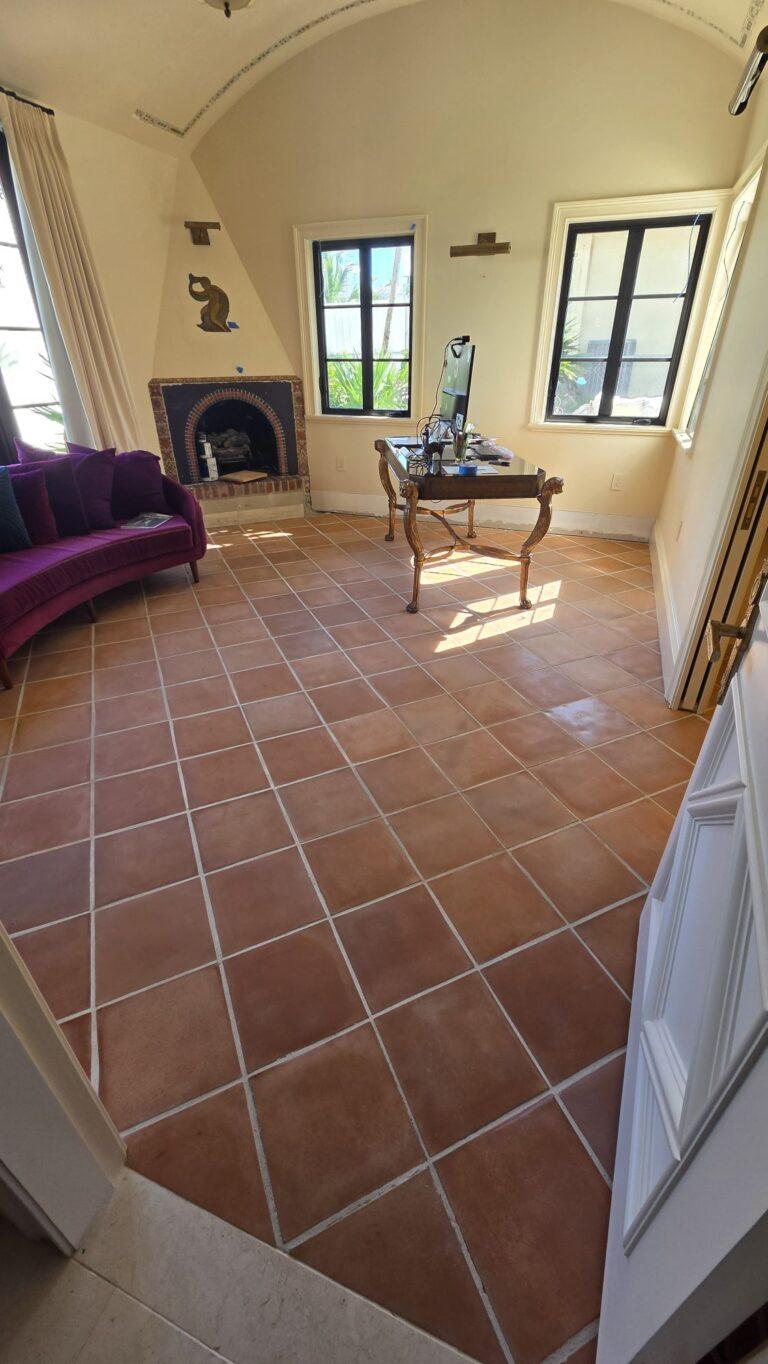
Real terracotta tile floor laid on the diagonal in a Miami Beach home
The real terracotta downstairs, Miami Beach.

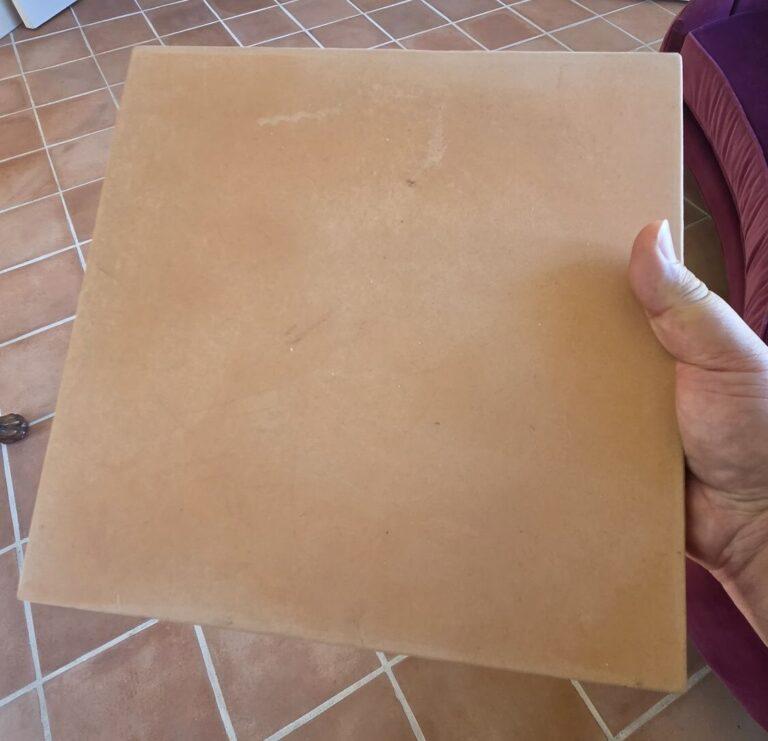
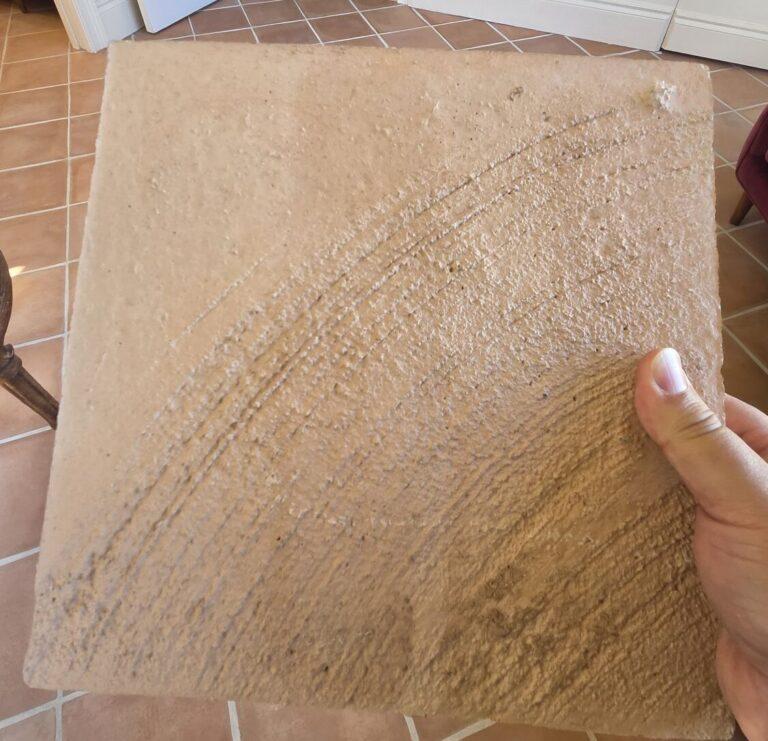
The name tells you what to look for. Terracotta is Italian for "baked earth." Real terracotta is fired clay. It feels earthy, and you can smell the clay. The new tiles felt off in the hand, and the smell was a little off too. Flipping one over settled it, because the back was concrete. Our crew saw the same thing right away.

Front of a concrete tile made to look like terracotta, held over a real terracotta floor in Miami BeachBack of the look-alike tile showing concrete, held over a real terracotta floor in Miami Beach
The look-alike from the new shipment: the front, and the concrete back.

Water gives it away as well. Real terracotta soaks it in within a few minutes. On the concrete look-alike, the water lingers on top and stays wet longer.

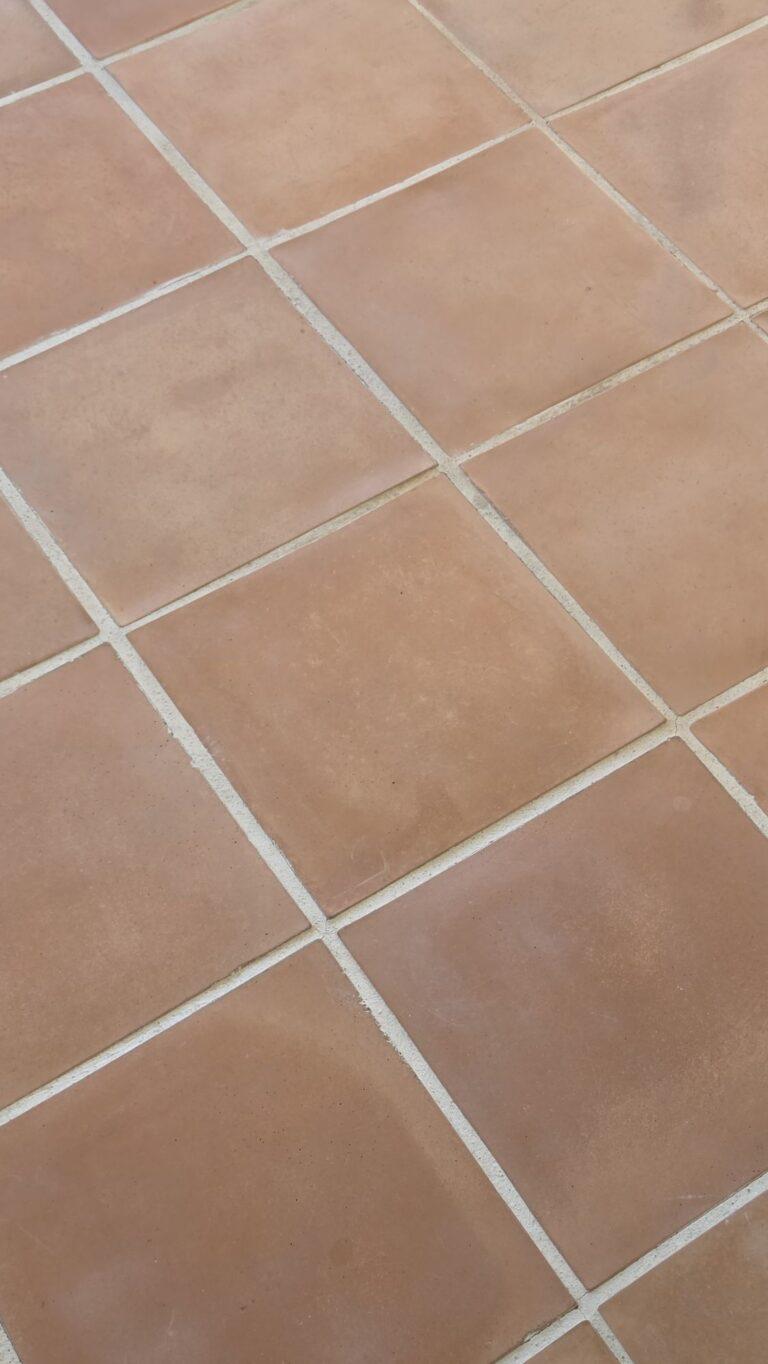
Sealer freshly applied to a real terracotta hallway floor in a Miami Beach homeClose-up of real terracotta floor tiles and grout in a Miami Beach home
Sealer going down on the real terracotta hallway, and a close-up of the real tile.

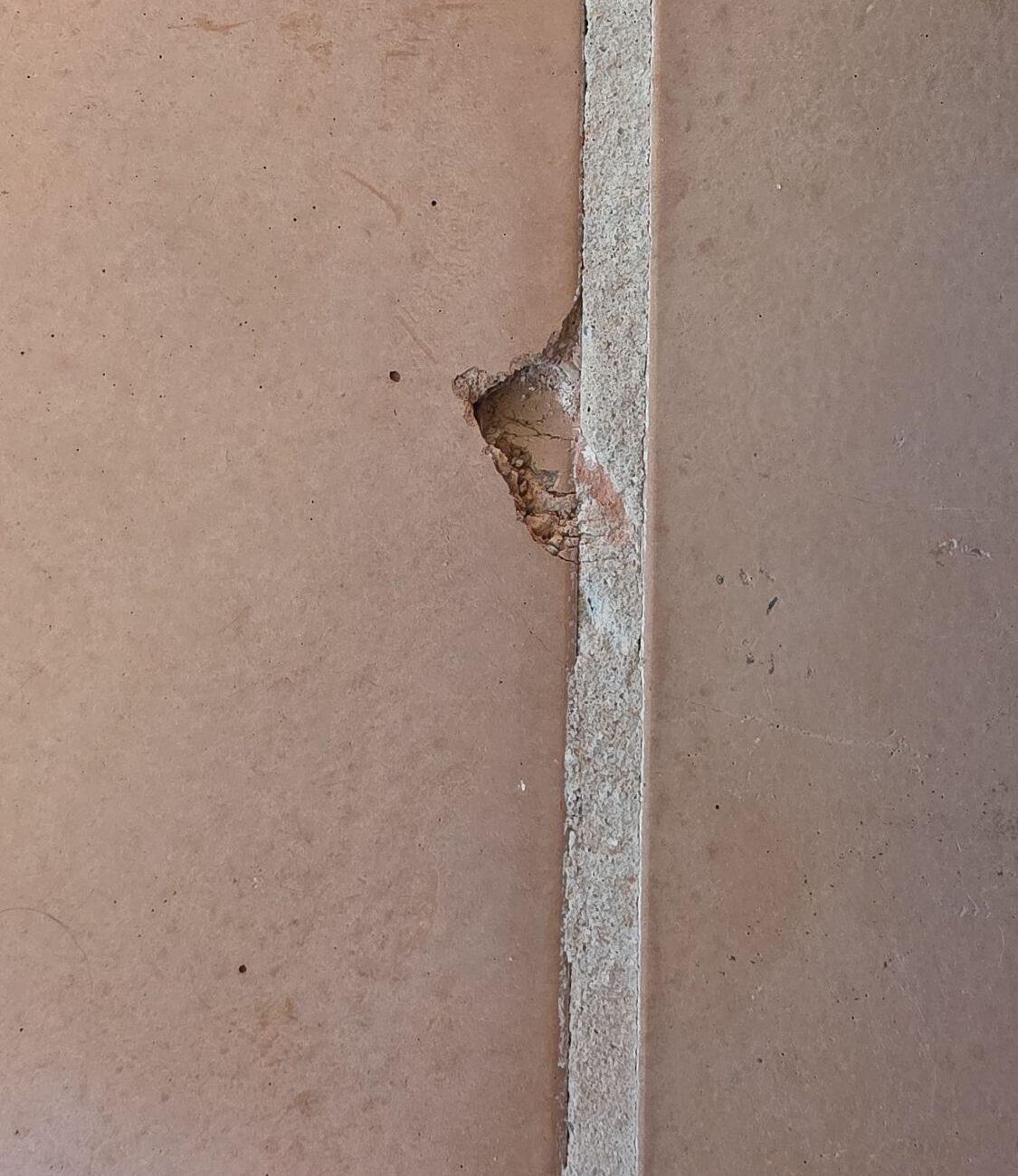
The homeowner called the supplier, and they confirmed it. The new tiles were a concrete imitation, not terracotta. Then she wanted to know if the original floor downstairs was real too. Miguel told her it was, and a chipped tile in that floor backed him up.

It is one more reason we look at a clay floor in person before we plan the work.

Chipped edge of an original terracotta floor tile in a Miami Beach home

A chipped tile in the original terracotta floor, Miami Beach.

Where We Restore Terracotta and Saltillo

We work on clay floors across Miami-Dade County and the Florida Keys, including Miami Beach, Coral Gables, Pinecrest, Key Biscayne, Coconut Grove, Kendall, Brickell, Sunny Isles Beach, Aventura, Key Largo and the rest of the Florida Keys. Every clay floor starts with a $250 on-site assessment, credited in full toward the work, because the right plan depends on what the floor actually is.

Frequently Asked Questions

Is saltillo the same as terracotta?

Saltillo is a type of terracotta, but not all terracotta is saltillo. Terracotta is the broad category of clay tile and can be made anywhere. Saltillo is handmade, sun-dried clay tile that comes only from the area around Saltillo, Mexico.

How can I tell if my floor is saltillo or terracotta?

Look at the shape, the color and the grout. Machine-made terracotta is usually smooth and flat, one even reddish brown, with tiles that are all the same size and thin grout lines. Saltillo has wavy surfaces, bumpy edges, blends of peach, yellow and red, slightly different tile sizes, and thick grout lines.

Do paw prints in the tile mean it is saltillo?

Very often, yes. Saltillo is dried outside in the sun, so dog paw prints, bird tracks and leaf imprints get baked right into the tile. Machine-made terracotta does not have them.

Are saltillo and terracotta cleaned the same way?

The everyday cleaning chemistry is the same, because both are raw clay. The difference is that saltillo is much more porous than machine-made terracotta, so it needs maintenance more often.

Why does my clay tile floor look yellow or brown?

Usually it is not the tile. Layers of wax and acrylic applied over the years without ever being stripped oxidize into a yellow-brown haze, and in South Florida humidity gets trapped under them. Once those layers are stripped, the clay underneath is usually the same color it always was.

Can rust stains, paint and haze come off terracotta tile?

On this Miami Beach floor we removed rust streaks, paint splatter and cement haze with low-moisture work, chemistry plus controlled extraction, then applied a transparent sealer. Every clay floor is different, so we assess it in person before we plan the work.

How can I tell real terracotta from a concrete look-alike?

Real terracotta is fired clay. It feels earthy, it smells like clay, and it soaks in water within a few minutes. A concrete look-alike feels off in the hand, water lingers on top and stays wet longer, and the back of the tile shows concrete. On a Miami Beach job, our crew spotted a concrete look-alike in a new shipment, and the supplier confirmed it.

Do you restore terracotta and saltillo floors in Miami-Dade and the Florida Keys?

Yes. Keep It Clean Tile and Grout restores terracotta and saltillo floors across Miami-Dade County and the Florida Keys, including Miami Beach, Coral Gables, Pinecrest, Key Biscayne and Key Largo. The $250 on-site assessment is credited in full toward the work. Call or text 305-741-9729.

Not Sure Which Clay Floor You Have?

Keep It Clean Tile and Grout restores terracotta, saltillo and natural stone across Miami-Dade County and the Florida Keys.

Veteran-Owned | 25+ Years | 185+ Five-Star Reviews
★★★★★ Read our reviews on Google

The $250 assessment is credited in full toward your service.

Call or text: 305-741-9729

Always Local. Always On Time. Always Honest.


Why Mold Keeps Coming Back in Your Shower Grout in Miami

Why Mold Keeps Coming Back in Your Shower Grout in Miami

You scrub the dark lines in your shower grout, they look better for a week or two, then the black comes right back. In Miami, that cycle is closer to the rule than the exception, and it usually means the growth was never really gone.

Short answer: Shower grout mold keeps coming back because grout is porous and holds onto soap film and moisture, so surface scrubbing only clears the top layer while the growth underneath stays put. In Miami's humidity it re-establishes fast. A proper cleaning treats the organic growth with a chlorine dioxide (ClO2) step, then cleans and extracts from inside the grout with a low-moisture oxidation system, no high-pressure steam. After that, keeping it back is about moisture and airflow, and we will tell you straight if that is what you are actually dealing with.

Surface Mildew vs. Mold Set Into the Grout

People use mold and mildew to mean the same thing, but the difference decides whether scrubbing will ever work. Mildew sits on the surface. It is usually gray, green, or a light black film on the caulk and the top of the grout, and a good cleaner wipes most of it away. Mold is different. It works down into the pores of the grout and into the silicone bead in the corners, so the part you see is only the tip. Wipe the surface and the color fades for a few days, then it feeds back up through the same lines.

Miami makes this worse than most places. Warm air, long humid stretches, and a shower that gets used every day keep the grout damp far longer than it would stay damp up north. Damp, porous, and fed by soap film is exactly the condition this growth likes.

Which one is your grout?

  • Wipes to a lighter gray or green and comes back slowly: usually surface mildew on the caulk or grout face.
  • Dark spots or black lines that return within a week of scrubbing: growth set down inside porous grout.
  • Black creeping along the silicone corner bead: mold in the caulk, which needs the bead cut out and replaced, not just cleaned.
  • One grout line gone darker than the rest and it will not lighten: staining that may call for color sealing rather than more cleaning.

Why It Keeps Coming Back No Matter How Hard You Scrub

Grout is cement based and full of tiny pores. Every shower leaves behind a thin layer of soap, body oil, and minerals, and that film settles into those pores and becomes food. A brush and a spray bottle reach the surface, but they do not pull that buildup back out of the grout, so the growth that is living below the surface is untouched. Add a corner of aging silicone that has taken on moisture, and you have a source that reseeds the whole line.

Bleach makes this confusing. It lightens the color of what is on top, so the grout looks clean, but the structure underneath is still there and still damp. That is why the "clean" look off a bottle of bleach rarely lasts more than a week or two in a Miami bathroom. The problem was never really the color. It was what the color was growing out of.

Sound like your shower? That is the exact job we do every week in Miami bathrooms.

Not sure if it is surface mildew or mold set into the grout? Text a photo to 305-741-9729 and we will tell you what you are actually dealing with.

How a Low-Moisture Cleaning Actually Reaches It

When growth has set into the grout, the work has three parts. First we treat the organic growth with a chlorine dioxide (ClO2) step, since that is the part a surface wipe leaves behind. Then our low-moisture oxidation system, BoosTiO2, breaks the soap film and organic grime down at the molecular level so it lets go of the pores. Then we agitate with a soft brush and extract the loosened soil and moisture back out, rather than pushing water deeper into the wall. No high-pressure steam and no spinners, which drive moisture into places you do not want it in a humid climate.

The products are plant based and pH balanced, which matters in a shower where kids and pets are around and where the tile may be natural stone. Acidic cleaners like vinegar and lemon etch calcareous stone such as marble and travertine, so on those surfaces the wrong bottle from under the sink does lasting damage. If the grout is stained deeper than cleaning can reach, grout color sealing resets it to an even color. And once it is clean, SouthShield grout protection helps the grout shed moisture and soap instead of soaking them up. We never seal dirty grout, because sealing traps whatever is under it.

We Will Tell You If You Do Not Need a Cleaning

Sometimes what you have is light surface mildew you can stay ahead of on your own, or a bathroom fan that is not moving enough air, or a strip of silicone that just needs replacing. If that is the case, we will say so. We would rather tell you the honest fix than book a job you do not need. When a cleaning is the right call, the $250 assessment is credited in full toward the service.

Frequently Asked Questions

Why does the mold come back so fast in my shower?

Because the part you scrub off is only the surface. The growth lives inside porous grout and old silicone, fed by soap film and the moisture a daily shower leaves behind. Until that buildup is pulled out of the pores, it keeps feeding back up through the same lines, and Miami humidity speeds the whole cycle up.

Can I just use bleach on it?

Bleach lightens the color of what is on the surface so the grout looks clean, but it does not reach the growth down in the grout or in the caulk, and it can discolor colored grout and damage natural stone. We use plant based, pH balanced products with a chlorine dioxide step for the organic growth, then extract it rather than bleaching it out of sight.

Is the cleaning safe for kids, pets, and natural stone?

Yes. The products are plant based, pH balanced, and safe around kids and pets, and the method is low moisture with no high-pressure steam. On natural stone we stay away from acidic cleaners, since acid etches calcareous stone like marble and travertine.

Will the mold stay gone after you clean?

A cleaning resets the grout, but how long it stays that way comes down to moisture and airflow. We will point out what is driving it in your bathroom, whether that is grout that needs color sealing, worn silicone, or a fan that is not clearing the air, so you can keep it in check between cleanings.

Talk to a Local Tile and Grout Team

Keep It Clean Tile and Grout has worked on South Florida tile since 2002. We are veteran-owned and family-operated, with 25+ years on the job and 185+ five-star reviews, serving Miami-Dade County and the Florida Keys.

Not sure if it is surface mildew or mold set into the grout? Text a photo to 305-741-9729 and we will tell you what you are actually dealing with.

Call or text: 305-741-9729

Always Local. Always On Time. Always Honest.


Should You Seal Your Grout in South Florida? What Miami Homeowners Should Know

Should You Seal Your Grout in South Florida? What Miami Homeowners Should Know

Sealing gets talked about like it's automatic, something every floor needs on a schedule. The honest answer is more nuanced. Sealing helps in most Miami homes, but only when it's done on the right surface, at the right time, for the right reason. Here's how to think about it.

What a Sealer Actually Does

A penetrating, or impregnating, sealer soaks into the pores of the grout and makes it more resistant to absorbing liquids. That's the key word: resistant, not proof. A sealer isn't a force field. It buys you time. When something spills, it beads and sits on top long enough for you to wipe it up instead of soaking straight into the joint. In a climate where grout fights moisture year-round, that head start matters.

Why It Helps More in Miami

Our humidity and hard water are hard on grout. Unsealed joints drink in moisture, mineral deposits, and spills, which is what drives the mold, mildew, and darkening that Miami floors are prone to. Sealing slows all of that down. It won't stop you from ever needing our Miami tile and grout cleaning service again, but it stretches the time between cleanings and makes the ones you do need easier.

The One Rule That Matters Most

Never seal dirty grout. This is where DIY sealing goes wrong. If you apply sealer over embedded soil or contamination, you lock the problem in permanently, sealing the dirt inside the joint where nothing can reach it. Sealing is the last step after a proper deep cleaning, once the grout is clean and fully dry, never a shortcut to skip the cleaning. We apply our SouthShield sealer as a separate step for exactly this reason.

When Cleaning Won't Be Enough

Sometimes grout is too far gone to seal clear. If the color is permanently stained or blotchy even after a deep clean, a clear sealer just protects an ugly result. In those cases grout color sealing is the better move. It coats the grout in a uniform, stain-resistant color that resists water, mold, and mildew, and it makes a tired floor look new again.

A Note on Natural Stone

If your floor is natural stone rather than ceramic or porcelain, the rules shift. Many stones don't need sealing at all, and the wrong product or an acidic cleaner can etch or dull the surface. Marble and travertine are especially sensitive. Stone should be assessed on its own terms, not lumped in with tile.

Talk to a Local Tile and Grout Team

Keep It Clean has cleaned and restored floors in Miami's exact climate since 2002. Veteran-owned, family-operated, and backed by 185+ five-star reviews across Miami-Dade County and the Florida Keys.

Send photos and video of your floors by call or text for a quote. If that's not practical, a $250 assessment fee applies, paid via Zelle to confirm your appointment and credited in full toward your service.

Call or text: 305-741-9729

Always Local. Always On Time. Always Honest.

Grout Haze or Just Dirty Grout? How to Tell What’s on Your Miami Floor

Grout Haze or Just Dirty Grout? How to Tell What’s on Your Miami Floor

A cloudy, dull film across your tile looks like dirt, so most people try to clean it. When cleaning doesn't touch it, they clean harder. If that sounds familiar, you may not be dealing with dirt at all. You may be looking at grout haze, and it's a completely different problem with a completely different fix.

Short answer: If the cloudiness sits in the grout lines and follows your walking paths, it's dirt, and deep tile and grout cleaning will lift it. If it's a uniform, chalky film across the whole floor, tile included, and it showed up soon after installation or sealing, it's grout haze, and haze has to be corrected off the surface, not cleaned.

What Dirty Grout Looks Like

Ordinary soil concentrates in the grout lines. The joints go dark while the face of the tile stays relatively clear. It builds gradually, it's worse in high-traffic paths, and it responds to proper deep cleaning and extraction. If your problem is confined to the lines and follows the walkways through your home, that's soil.

What Grout Haze Looks Like

Haze is different. It's a thin, cloudy film that sits across the whole surface, tile and grout alike, giving the floor a chalky or dull cast even right after you've mopped. It's most common on newer installations, and it's not dirt. It's residue left behind when grout or a coating wasn't cleaned off properly during or after installation. Because it's bonded to the surface, cleaning doesn't remove it. You can mop every day and the haze stays exactly where it is.

Why the Difference Matters

If you treat haze like dirt, you'll spend time and money on cleanings that can't work, because cleaning and correction are two different services. Soil gets cleaned out. Haze gets corrected off. There's also more than one kind of haze. Standard cementitious haze is one thing. Polymer or epoxy haze from modern grouts and sealers is tougher, chemically bonded, and needs a specific removal process. Using the wrong approach on the wrong haze can damage the tile.

A Quick Way to Tell Them Apart

Look at where the problem lives. If it's in the grout lines and follows traffic patterns, it's probably soil and a good cleaning will help. If it's a uniform film across the entire floor, tile included, and it showed up after a recent installation or sealing, it's probably haze and it needs correction rather than cleaning. When you're not sure, a short video of the floor usually tells us which one you're dealing with before we ever quote it.

Frequently Asked Questions

Can I remove grout haze by mopping or with a household cleaner?

No. Grout haze is a bonded residue, not loose dirt, so mopping and everyday cleaners don't touch it. It needs a haze-removal process matched to the type of haze. Using a random acid or scrubbing pad can etch or scratch the tile, which is why it's worth identifying the haze first.

How can I tell if it's grout haze or just dirty grout?

Look at where the cloudiness lives. Dirt sits in the grout lines and follows the paths you walk. Haze is a uniform film across the whole floor, tile included, and it usually appears right after a tile install or a sealing job. If the whole floor looks dull even when it's clean, it's most likely haze.

Is polymer or epoxy grout haze different from regular haze?

Yes. Standard cementitious haze is relatively straightforward to remove. Polymer and epoxy haze from modern grouts and sealers is chemically bonded and much tougher, so it needs a specific removal method. The wrong approach on the wrong haze can permanently damage the surface.

Do you remove grout haze in Miami?

Yes. Keep It Clean handles grout haze and polymer haze removal across Miami-Dade County and the Florida Keys. Send a short video of the floor and we can usually tell you whether you're dealing with haze or soil before we quote.

Talk to a Local Tile and Grout Team

Keep It Clean has cleaned and restored floors in Miami's exact climate since 2002. Veteran-owned, family-operated, and backed by 185+ five-star reviews across Miami-Dade County and the Florida Keys.

Send photos and video of your floors by call or text for a quote. If that's not practical, a $250 assessment fee applies, paid via Zelle to confirm your appointment and credited in full toward your service.

Call or text: 305-741-9729

Always Local. Always On Time. Always Honest.